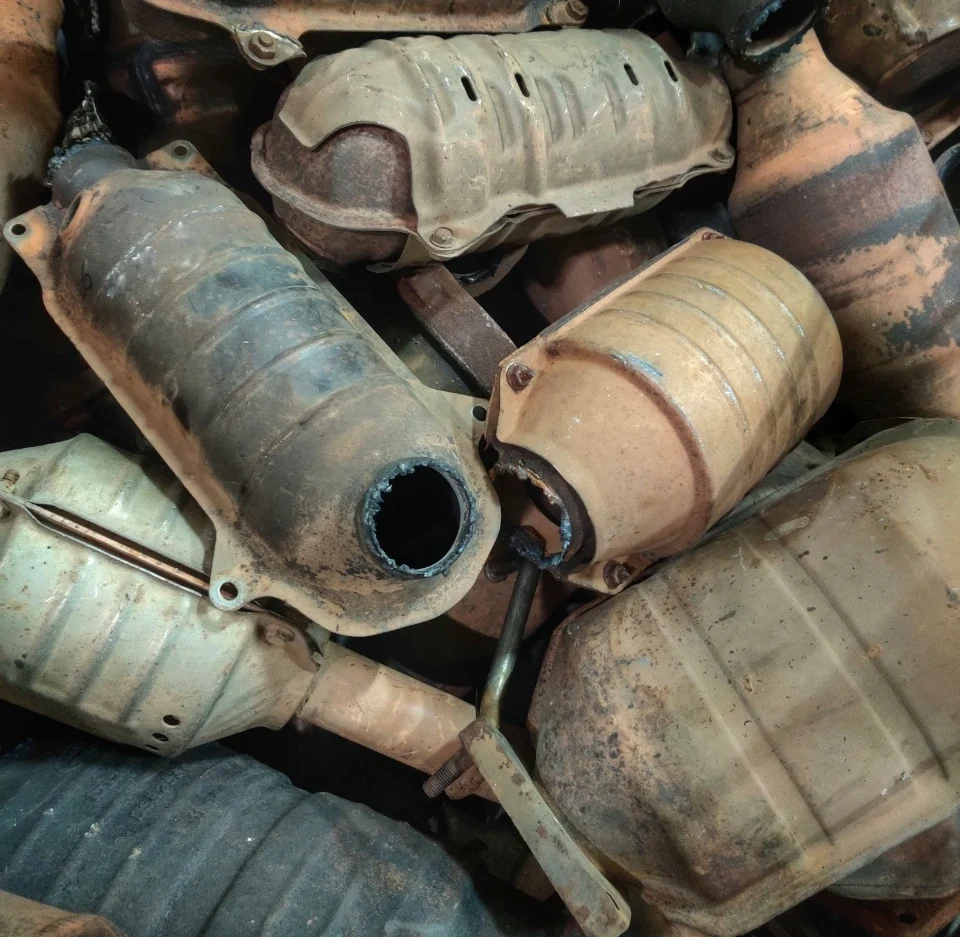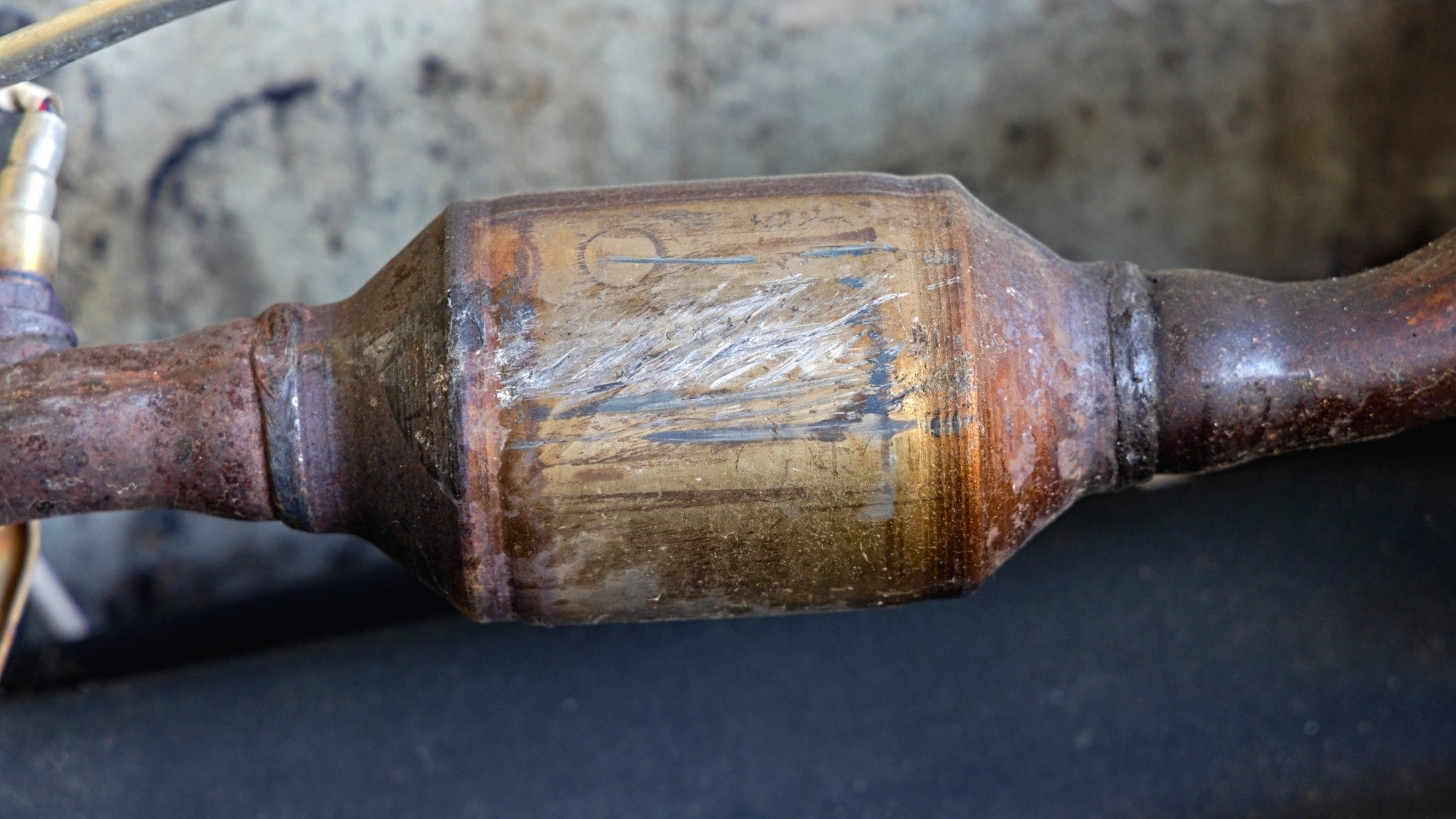

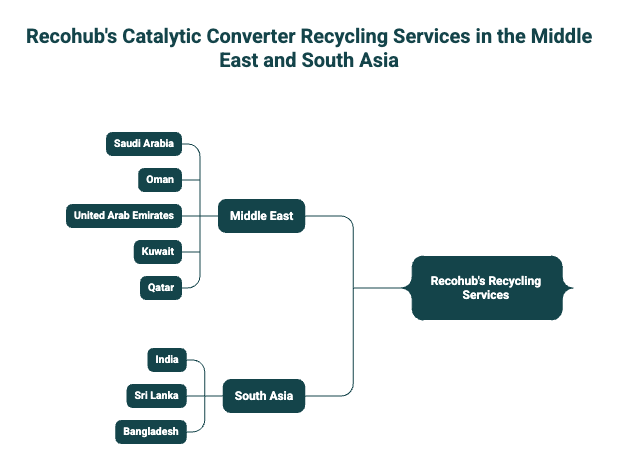
If you have a used catalytic converter from a scrapped or old vehicle and want to sell it for its precious metal value, this guide covers everything you need to know. We break down the paperwork required in India, Saudi Arabia, the UAE, and five other countries we serve, explain how local selling differs from exporting, and show you how to get the best catalytic converter price without running into legal trouble.
To sell a used catalytic converter legally, you generally need proof of ownership (vehicle deregistration papers or a receipt showing where the converter came from), a valid ID, and a licensed buyer. In most Middle Eastern and South Asian countries, selling catalytic converters without documentation risks fines, confiscation, or criminal charges – especially as governments crack down on converter theft. Working with an international recycler like Recohub ensures your sale is fully compliant, your converter is properly assayed for its actual platinum, palladium, and rhodium content, and you receive a fair market price based on current precious metal rates.
Why Is My Used Catalytic Converter Valuable and What Determines Its Price?
Your used catalytic converter is valuable because it contains platinum group metals (PGMs) – specifically platinum, palladium, and rhodium – that are essential for automotive emission control and other industrial processes. These three metals are among the rarest and most expensive materials on Earth. As of early 2026, platinum trades at roughly $2,000-$2,200 per troy ounce, palladium at $1,700-$1,850, and rhodium at $9,750-$10,825 per troy ounce.
The amount of PGMs inside a converter varies significantly by vehicle make, model, and engine size. A small hatchback might carry $30-$80 worth of recoverable metals, while a large SUV or a BMW converter from a luxury vehicle could contain $150-$500 or more. Diesel vehicles typically use palladium and platinum in different ratios than petrol engines, which affects the value profile. The converter’s age and condition also matter – a well-preserved unit from a relatively new vehicle yields more than a heavily corroded one.
To understand what your specific converter could be worth in today’s market, read our detailed breakdown of how much a catalytic converter is worth in the Middle East and South Asia in 2026. The only way to know the exact value is through a professional assay – a laboratory analysis that measures the precise PGM content. This is exactly what Recohub provides to every seller.
PGM Content and Estimated Value by Vehicle Type
Vehicle Type | Typical PGMs Present | Approx. Value Range | Notes |
Small car / hatchback | Palladium, small rhodium | $30 – $80 | Lower engine displacement, less PGM loading |
Mid-size sedan | Palladium, platinum, rhodium | $80 – $200 | Standard three-way catalyst |
SUV / Truck | Higher palladium & rhodium loads | $150 – $350 | Larger engines require more catalyst material |
BMW / Luxury | High platinum, palladium, rhodium | $200 – $500+ | Premium brands use higher PGM loads for emissions compliance |
Diesel vehicle | Platinum-heavy, some palladium | $50 – $250 | Diesel oxidation catalysts vary widely |
Note: Values are approximate ranges based on early 2026 PGM spot prices and typical PGM loadings. Actual value depends on professional assay results.
What Paperwork Do I Need to Sell a Catalytic Converter in My Country?
In every country Recohub serves, you will need at minimum two things: proof of ownership and a valid government-issued ID. Beyond that, requirements diverge significantly by jurisdiction. Some countries require the buyer to hold a scrap trading licence, others mandate environmental clearances for handling precious-metal-bearing waste, and a few have recently introduced specific regulations targeting catalytic converter sales in response to rising theft.
The rise of catalytic converter theft and the black market has pushed governments across the Middle East and South Asia to tighten regulations. Selling to unlicensed buyers not only risks a lower price – it could expose you to criminal liability if the transaction lacks a proper paper trail. Below is a country-by-country summary of what legitimate sellers need to know.
Country-by-Country Paperwork Requirements for Selling a Catalytic Converter
Country | Key Documents Required | Licensing Authority | Special Notes |
India | Vehicle deregistration certificate (Form 30), valid ID (Aadhaar/PAN), GST registration if selling commercially | State RTO; Central Pollution Control Board (CPCB) | E-waste and scrap metal dealers may need CPCB authorisation under Hazardous Waste Management Rules |
Sri Lanka | Motor Traffic Dept deregistration, National ID, Environmental Protection Licence for commercial sellers | Central Environmental Authority (CEA) | Scrap metal exports require Department of Import/Export Control clearance |
Saudi Arabia | Vehicle ownership transfer docs (Istimara), Iqama/National ID, commercial registration for dealers | General Authority of Meteorology and Environment (now MEWA) | Scrap trade regulated under Zakat, Tax and Customs Authority; VAT applies |
Oman | Vehicle deregistration from ROP, Omani ID/passport, trade licence for commercial operations | Environment Authority of Oman | Environmental clearance required for waste containing precious metals |
United Arab Emirates | Vehicle export certificate (RTA), Emirates ID, municipality waste trading permit for dealers | Ministry of Climate Change and Environment; local municipality | Free Zone entities have separate regulations; Dubai and Abu Dhabi rules may differ |
Kuwait | Vehicle ownership proof, Civil ID, commercial licence for scrap businesses | Environment Public Authority (EPA Kuwait) | Strict rules on recycling waste containing heavy metals; EPA authorisation needed for export |
Qatar | Vehicle deregistration (MOI Traffic Dept), QID, commercial registration for businesses | Ministry of Environment and Climate Change | Hazardous waste management laws apply; commercial sellers need environmental impact assessment |
Bangladesh | BRTA vehicle deregistration, National ID (NID), trade licence for dealers | Department of Environment (DoE) | Ship breaking and scrap import/export heavily regulated; DoE clearance needed for precious metal waste |
Always verify current requirements with your local authority, as regulations are updated frequently. Recohub’s team can help guide you through the paperwork for your specific country.
If you are unsure about any documentation requirements, Recohub can walk you through the process for your specific country. Our team works with sellers across all eight countries daily and understands the nuances of each regulatory framework. Getting the paperwork right protects both parties and ensures the transaction is fully traceable – which is increasingly important as enforcement tightens.
How Do the Rules Change if I Sell Locally vs. Export My Catalytic Converters to Another Country?
Selling a catalytic converter to a buyer within your own country is significantly simpler than exporting it across borders, which adds customs declarations, environmental compliance, and potential Basel Convention obligations to the process. Understanding the difference is critical, because getting cross-border shipments wrong can result in confiscation at customs, heavy fines, or even criminal charges.
A local sale typically involves verifying ownership, agreeing on a price, and completing the transaction with a licensed buyer. The converter stays within the country’s borders and is subject only to domestic scrap trading rules. Export, however, means shipping precious-metal-bearing material internationally – and that triggers a different set of regulations entirely.
The Basel Convention is an international treaty ratified by 191 countries – including India, Sri Lanka, Saudi Arabia, Oman, the UAE, Kuwait, Qatar, and Bangladesh – that governs the cross-border movement of hazardous waste and recyclable materials. Catalytic converters contain trace amounts of hazardous substances alongside their precious metals. Depending on how your country classifies them, exporting converters may require prior informed consent from the importing country, export licences, and detailed documentation of the material’s composition.
This is precisely where working with a company like Recohub makes the process dramatically easier. Based in the UAE – one of the world’s premier logistics and trade hubs – Recohub handles the shipping, customs, compliance, and delivery to globally recognised refineries. Sellers don’t need to navigate the Basel Convention requirements themselves; Recohub‘s operations are built around ensuring every shipment is fully legal and properly documented from origin to final processing.
Local Sale vs. Cross-Border Export – Requirements Comparison
Requirement | Local Sale | Cross-Border Export |
Documentation | Proof of ownership, valid ID, sale receipt | All local docs + customs declaration, material composition certificate, export permit |
Licences | Buyer needs scrap trading licence in most countries | Exporter needs environmental clearance, waste export licence, and trade permit |
Customs | Not applicable | Full customs declaration required; HS codes for precious metal scrap apply |
Basel Convention | Not applicable | Prior informed consent may be required from importing country; full compliance mandatory |
Timeline | Same day to a few days | Weeks to months depending on country approvals |
Risk Level | Low (if selling to licensed buyer) | Higher – confiscation, fines, criminal charges for non-compliance |
Best Approach | Sell to a licensed local recycler or aggregator | Work with an international recycler like Recohub that handles all logistics and compliance |
For sellers in India, Sri Lanka, Saudi Arabia, Oman, the UAE, Kuwait, Qatar, and Bangladesh, the simplest path is clear: sell your car catalytic converter to a partner who already has the infrastructure, licences, and international relationships in place. That eliminates the compliance burden entirely while ensuring you receive a price based on the actual precious metal content – not a lowball estimate from an informal buyer.
Why Should I Sell to a Licensed Recycler Instead of the Informal Market?
Licensed recyclers offer assay-based pricing, legal protection, and the assurance that you are not unknowingly participating in a stolen goods supply chain. The informal market for automobile catalytic converters is rife with problems – from criminal networks fencing stolen converters to unlicensed middlemen who lack the equipment to accurately value what they are buying.
Catalytic converter theft has become a global crisis. Converters can be cut from under a parked vehicle in under two minutes, and the stolen units enter an opaque supply chain where origin is deliberately obscured. Our in-depth investigation into what happens to stolen catalytic converters and the black market reveals how stolen converters move through informal channels, why prices paid by unlicensed buyers are consistently below fair value, and the legal risks for everyone involved.
When you sell through the informal market, the buyer typically estimates the converter’s value based on its external appearance or a reference number lookup – not on the actual PGM content inside. This method routinely undervalues converters by 20-40%. A licensed recycler like Recohub performs a professional assay, measuring the exact grams of platinum, palladium, and rhodium and pricing against current spot rates. The difference in payout can be substantial.
Equally important is legal protection. If authorities trace a stolen converter to a sale you were involved in – even if you had no idea it was stolen – you could face criminal charges. A documented sale to a licensed recycler with a clear paper trail protects you completely.
How Does the Recycling Process Work When I Sell My Catalytic Converter to Recohub?
Recohub operates a transparent, end-to-end process: from first contact through to assay, pricing, and payment, every step is documented and compliant. Based in the United Arab Emirates – at a strategic crossroads between South Asia, the Middle East, and global refining centres – Recohub connects collectors, recyclers, and refiners across the entire precious metals recovery chain.
The process works in five stages. First, you contact Recohub through the website or by reaching out directly. The team assesses your converters based on initial information – vehicle make, model, quantity, and photos. Second, Recohub confirms the documentation requirements for your specific country and helps you prepare the necessary paperwork. Third, logistics are arranged; depending on your location and volume, Recohub coordinates collection or provides shipping instructions to its UAE processing facility.
Fourth – and this is where the value becomes clear – your converters undergo a professional assay. The ceramic substrate inside the converter is carefully extracted, ground into a homogeneous sample, and analysed in a laboratory to determine the exact platinum, palladium, and rhodium content. Pricing is calculated transparently against current PGM market rates. Fifth, settlement is processed promptly with flexible payment options.
From there, the processed material is delivered to globally recognised and publicly listed refining plants for final PGM recovery. This closed-loop system ensures every gram of precious metal is accounted for, every transaction is documented, and every seller receives fair value for their catalytic converter scrap price.
Ready to Sell Your Catalytic Converter?
Selling a used catalytic converter does not have to be complicated or risky. With the right paperwork and a licensed recycler, you get a fair price based on what your converter actually contains – and full legal protection for the transaction.
Whether you are in India, Sri Lanka, Saudi Arabia, Oman, the UAE, Kuwait, Qatar, or Bangladesh, Recohub offers transparent assay-based pricing, full legal compliance, and a professional recycling process from start to finish. Our team handles the documentation, logistics, and delivery to world-class refining facilities so you can focus on getting the best value for your material.
Have catalytic converters you want to sell? Contact Recohub today for a quote – our team is ready to help.