
Hybrid battery scrap value in 2026 depends on three things: battery chemistry (NiMH or Li-ion), the car model it came from, and which region you are selling in. This guide breaks down real scrap value ranges by battery type, vehicle model, condition grade, and market – so you know exactly what to expect before you call a dealer. It also covers the EU Battery Regulation and 2026 Basel export rules now reshaping who can buy your pack, plus how to test a pack’s state of health before you buy or sell.
In 2026, a standard NiMH hybrid battery from a Toyota Prius or Honda Accord is typically worth $15-50 as scrap, driven largely by nickel content. A Li-ion hybrid battery from a newer model – particularly one with NMC chemistry – can fetch $30-120 or more, depending on weight and cobalt content. As tracked by Benchmark Mineral Intelligence, cobalt and lithium prices have stabilised in 2026 after years of volatility, giving the scrap market more predictable value floors than in previous years. UAE and UK markets generally pay 20-40% above Indian and South African rates due to better processing infrastructure and export demand.
Read on for a full breakdown by battery chemistry, car model, condition grade, and selling region.
Key takeaways
- A standard NiMH hybrid pack (Toyota Prius, Honda Accord) is typically worth $15-50 as scrap in 2026; Li-ion NMC packs run $30-120 or more, driven by cobalt content and weight.
- Value depends on four things: chemistry (NiMH vs Li-ion), vehicle model and pack weight, condition grade (A to D), and the region you sell in.
- A working (Grade A) pack can be worth 2-4 times a dead one, because refurbishers pay a premium over smelters.
- The UAE and UK generally pay more than India and South Africa due to processing and export infrastructure.
- The Basel Convention’s 2025 e-waste amendments now control all hybrid battery exports under a single Prior Informed Consent (PIC) system, and the Y49 listing closes the old “used auto parts” loophole.
- Grey export routes through the UAE, India, Saudi Arabia and Oman are being shut down, which pushes more volume to licensed processors and means fairer, more transparent prices for legitimate sellers.
- To get the best price safely, sell to a Basel-compliant licensed buyer that uses chemistry-based pricing and issues full chain-of-custody documentation.
- Before you buy or sell, check the battery’s state of health (SOH): above 80% is strong, 60-80% is fair, below 60% is recycling-grade – SOH and cell-voltage spread are what set the price.
- Exporting to Europe means complying with the EU Battery Regulation (2023/1542): correct UN classification, full documentation, and a digital Battery Passport phasing in from 2026 to 2027 – non-compliant shipments risk rejection at EU borders.
How Much Nickel Is in a Toyota Prius Battery – And What Does That Make It Worth as Scrap?
A Toyota Prius Gen 2/3 NiMH pack contains roughly 8-10 kg of recoverable nickel, worth approximately $120-180 in raw material terms – though dealers typically pay $15-50 after processing margins, transport, and refining costs are accounted for. That gap is why the realistic toyota prius battery scrap price sits well below the raw nickel value once a dealer’s margins are included.
NiMH Battery Composition: What the Metals Are Actually Worth
NiMH stands for nickel metal hydride battery – a chemistry built around a nickel-based positive electrode and a hydrogen-absorbing metal alloy on the negative side. That metal alloy contains rare earth elements (REEs) including lanthanum, cerium, neodymium, and praseodymium, which give the electrode its hydrogen storage capacity.
A single standard Prius NiMH pack weighs 35-42 kg in total. Breaking down the recoverable value by material:
| Battery Type | Key Recoverable Metals | Typical Pack Weight | Indicative Scrap Range (USD) |
|---|---|---|---|
| NiMH (Prius Gen 2/3) | Nickel (8-10 kg), lanthanum, cerium, neodymium | 35-42 kg | $15-50 |
| Li-ion NMC (Prius Gen 4+) | Nickel, manganese, cobalt, lithium | 44-50 kg | $40-90 |
| Li-ion LFP (entry hybrid models) | Lithium, iron, phosphate (no cobalt) | 30-45 kg | $20-55 |
| Li-ion NMC high-capacity (PHEV) | High nickel-cobalt, lithium, manganese | 90-130 kg | $80-200+ |
According to London Metal Exchange nickel pricing data, nickel spot prices in 2026 sit in the $15,000-$18,000 per tonne range. At 9 kg per Prius pack, that puts the raw nickel value at roughly $135-160. Licensed smelters recover 90-95% of the nickel content – but that recovery cost, plus transport and refinery margin, is what explains the gap between raw material value and dealer payout.
Why Dealers Don’t Pay Raw Metal Prices – How the Margin Works
Dealers typically pay 25-40% of gross recoverable material value. The remainder covers transport to a licensed processor, refining or smelting fees, energy costs, regulatory compliance, and the dealer’s own operating margin. Sellers who understand this avoid being surprised – and negotiate from a more informed position.
REEs like neodymium ($80-120/kg) add theoretical value to NiMH packs, but recovery rates in standard scrap streams are lower (60-80%). Most dealers price NiMH primarily on nickel weight and factor REEs as a secondary uplift.
Hybrid Battery Scrap Value by Car Model: Toyota, Lexus, Honda, Ford and More in 2026
Scrap values vary by model primarily because of battery weight, chemistry, and age. A RAV4 PHEV Li-ion pack is worth 4-6 times more than a Honda Insight NiMH pack – not because one brand is more reputable, but because of pack size and cobalt content. If you are checking the hybrid battery scrap value near me, expect local quotes to track these same factors, chemistry, weight, and condition, rather than the badge on the car.
Knowing your model and battery type before contacting a buyer is the single most effective way to get a better hybrid battery price.
| Model | Battery Type | Chemistry | Battery Weight | Indicative Scrap Value (USD) 2026 |
|---|---|---|---|---|
| Toyota Prius Gen 2/3 (2004-2015) | NiMH | Ni-MH | 35-42 kg | $15-35 |
| Toyota Prius Gen 4 (2016-2022) | Li-ion | NMC | 44-50 kg | $40-90 |
| Toyota Camry Hybrid | NiMH | Ni-MH | 35-42 kg | $15-35 |
| Toyota Highlander / Lexus RX Hybrid | NiMH | Ni-MH | 45-55 kg | $20-45 |
| Lexus ES / LS Hybrid (newer) | Li-ion | NMC | 40-60 kg | $35-85 |
| Honda Insight / CR-Z | NiMH | Ni-MH | 18-25 kg | $8-20 |
| Honda Accord Hybrid | NiMH | Ni-MH | 35-40 kg | $12-28 |
| Ford Fusion / Escape Hybrid | NiMH | Ni-MH | 35-45 kg | $12-30 |
| Toyota RAV4 PHEV | Li-ion | NMC high-capacity | 100-130 kg | $80-200+ |
Toyota and Lexus Group
Toyota accounts for the largest volume of scrap hybrid batteries globally, and NiMH Prius packs remain the most commonly traded unit in most markets. According to the IEA Global EV Outlook 2025, Toyota hybrids account for a disproportionate share of the ageing hybrid fleet now entering end-of-life recycling channels. The weight difference between a Honda Insight pack (20 kg) and a Lexus LS pack (55+ kg) is the primary reason prices diverge so sharply within the NiMH category alone.
Honda Group
Honda Insight and CR-Z packs are the lightest in the market – lower scrap value per unit, but faster to process and easier to transport in bulk. Accord Hybrid packs are heavier and accordingly priced higher. Honda has not yet moved its standard hybrid line to Li-ion at the scale Toyota has, so NiMH remains dominant in the Honda scrap stream.
Ford Group
Ford Fusion and Escape Hybrid packs use NiMH chemistry and fall in the mid-range by weight. Scrap values are comparable to Toyota Camry Hybrid – between $12-30 depending on market. Ford’s newer PHEV variants (Escape PHEV, F-150 PowerBoost) use Li-ion and command substantially higher scrap values, though these packs are not yet common in the scrap market in large volumes.
Dead, Degraded or Damaged: How the Condition of Your Hybrid Battery Changes What You Get Paid
A working hybrid battery can be worth 2-4 times more than a dead one – but even a fully failed battery retains scrap value as long as it is physically intact and has not been tampered with or thermally compromised.
Before you contact a buyer, assess your pack against these four condition grades. For a full technical walkthrough on how to test your battery, see the testing methods detailed later in this guide.
Grade A: Working Packs and the Refurbishment Premium
A Grade A battery holds a charge, passes a state-of-health (SOH – the percentage of original capacity remaining) test above 80%, and shows no cell imbalance. Per Toyota’s official hybrid battery warranty documentation, the battery management system in Prius and Camry models is designed to sustain 80%+ capacity well beyond 150,000 km under normal conditions – meaning many packs entering the scrap stream still have meaningful residual capacity. These packs can be sold into the refurbished market rather than straight to scrap – and that distinction matters. Refurbishers pay 2-4 times the scrap base rate because they resell reconditioned units to vehicle repair shops.
Grade A NiMH Prius packs can reach $60-120 in strong markets. Grade A Li-ion NMC packs from a RAV4 PHEV can exceed $300 if the capacity and cell balance are well-documented.
Grade B: Degraded Batteries and Module Harvest Value
Grade B covers packs with SOH between 60-80% – they still hold charge but performance is noticeably reduced. These packs are often bought for module harvesting: individual cell modules are extracted, tested, and recombined into rebuilt packs. A single cell module from a Prius Gen 2/3 pack sells for $3-8 depending on region, and a full pack contains 28 modules.
Dealers buying for module harvest pay above pure scrap but below full refurbishment price – typically $30-70 for a NiMH Prius pack in good structural condition.
Grade C: Dead Batteries – What Base Metal Scrap Actually Pays
Grade C batteries will not hold a charge at all. SOH is effectively zero. These go directly to licensed smelters or hydrometallurgical processors for base metal recovery. This is where the price ranges shown in the tables above apply – $15-50 for NiMH, $30-120 for Li-ion NMC, based purely on recoverable metal content by weight.
Grade D: Damaged or Punctured Packs – When Hazmat Costs Reduce Net Value
Grade D covers physically damaged packs – crushed casings, punctured cells, packs that have experienced a thermal event, swelling, or electrolyte leakage. These require specialist handling under hazardous materials regulations. Transport and disposal costs can equal or exceed base metal value on small packs. Larger Li-ion packs with significant cobalt content may still carry positive net value after hazmat surcharges – but sellers should disclose damage upfront and request a full net quote before agreeing to a price.
How to Test a Used Hybrid Battery’s Health Before You Buy or Sell
Hybrid batteries degrade gradually, and visible condition rarely tells the full story – a pack can look clean on the outside while hiding weak cells that drag down performance and value. Testing reveals the true state of health (SOH) behind the appearance, which is exactly what sets the price a buyer or recycler will offer. Accurately assessing SOH is also what decides whether a used pack is fit for reuse or only for material recovery; national labs such as NREL build state-of-health estimation tools precisely so used batteries can be evaluated for repurposing rather than scrapped by default.
How Long Should a Hybrid Battery Last?
Most hybrid batteries deliver reliable service for 8 to 15 years, or between 100,000 and 200,000 kilometres, depending on usage, climate, and maintenance. Frequent short trips, extreme heat, and aggressive driving accelerate degradation, while steady highway use often extends lifespan. Age matters less than actual SOH: a five-year-old pack with excellent cell balance can outperform a two-year-old unit that suffered heat damage or poor storage. NiMH is prized in hybrids for its thermal stability and long cycle life, which is why Toyota relied on it for decades, as this overview of NiMH in hybrid vehicles explains.
OBD-II Diagnostics and Trouble Code Analysis
The on-board diagnostic port gives direct access to battery management system data. Professional scan tools retrieve trouble codes, live voltage readings, and state-of-charge information. Consumer apps like Dr. Prius and Dr. Hybrid pair with a Bluetooth OBD reader to show battery health metrics on a smartphone, making basic diagnostics accessible to non-professionals. Key parameters include individual cell voltages, temperature differentials across the pack, and stored fault codes. Healthy NiMH cells typically hold 7.2 to 8.4 volts; significant variation between cells signals imbalance that needs attention.
Load Testing and Stress Analysis
Load testing applies controlled electrical demand while monitoring response, revealing how the pack handles real-world conditions that static voltage readings miss. Technicians watch voltage drop under load, recovery time after discharge, and heat generation. A common approach puts the vehicle in reverse, engages the electric motor while holding the brakes, and watches how quickly minimum and maximum cell voltages diverge. Healthy packs hold a tight voltage spread; degraded packs show widening gaps that indicate failing cells.
Capacity Testing and State of Health Calculation
State of health represents remaining capacity compared to original specification. Professional equipment measures actual amp-hour capacity through controlled discharge cycles, with results shown as a percentage – anything above 70% is generally serviceable for continued use. Recycling centres like Recohub run these assessments on incoming batteries: units with sufficient remaining capacity may qualify for refurbishment and resale, while those below threshold proceed to material recovery.
Battery Health Indicators at a Glance
The table below summarises the key metrics and what they mean for condition and value.
| Health Indicator | Good Condition | Fair Condition | Poor Condition |
|---|---|---|---|
| State of Health (SOH) | Above 80% | 60-80% | Below 60% |
| Cell Voltage Spread | Under 0.3V | 0.3V – 1.0V | Over 1.2V |
| Internal Resistance | Uniform across cells | Minor variations | Significant outliers |
| Trouble Codes | None present | Historical codes cleared | Active P3000-series codes |
| Resale / Recycling Value | Highest | Moderate | Recycling value only |
Warning Signs of a Failing Hybrid Battery
Several symptoms point to problems that testing will confirm. Dashboard warning lights – particularly the master warning and check-hybrid-system alerts – demand immediate attention and often appear before complete failure. Decreased fuel economy is another common sign: as battery capacity drops, the petrol engine works harder and burns more fuel. Erratic battery-gauge behaviour, reduced electric-only range, unusual cooling-fan noise, and sluggish acceleration all warrant testing. Catching these early maximises your options – repair, replacement, or selling before further degradation cuts the value.
Can You Test a Hybrid Battery Yourself?
Yes – basic testing is possible with consumer-grade equipment, though professional assessment is more comprehensive. A Bluetooth OBD-II adapter plus a hybrid diagnostic app lets you monitor cell voltages, temperatures, and fault codes from a smartphone. Safety matters: hybrid packs operate at 200 to 350 volts, so never open enclosures or touch terminals without proper training and equipment. Basic OBD diagnostics are safe because they only read data from the vehicle’s computer. Certified professional results carry more weight when buying or selling, and often pay for themselves through a better negotiating position.
Hybrid Battery Scrap Prices in the UAE, India, South Africa and UK – What Dealers Are Actually Paying in 2026
Regional scrap prices for hybrid batteries in 2026 range from $8-25 for NiMH in India to $50-130 for Li-ion in the UAE. The same battery can be worth three times more depending on where you sell it – and understanding why helps you decide where to direct your stock.
| Region | NiMH per Unit (USD) | Li-ion per Unit (USD) | Key Market Notes |
|---|---|---|---|
| UAE | $20-60 | $50-130 | Export-oriented, strong refinery access, highest per-unit payout in the region |
| India | $8-25 | $20-70 | High volume, price-sensitive market; growing Li-ion processing infrastructure |
| South Africa | $10-30 | $25-75 | Expanding market; fewer local Li-ion processors; export routes developing |
| UK | $15-40 | $35-100 | WEEE-regulated, certified channels required, consistent demand from dismantlers |
UAE
The UAE is currently the strongest-paying market for hybrid battery scrap in the GCC region. Dubai and Abu Dhabi operate as logistics and trading hubs, and several licensed buyers have direct relationships with European and Asian smelters. This access to international refining capacity allows UAE dealers to pay closer to global commodity benchmarks than markets with only local processing. Sellers in India, Saudi Arabia, or East Africa often find it worthwhile to consolidate volume and export to UAE-based buyers for a better hybrid battery price.
India
India operates the highest volume scrap market for hybrid batteries in South Asia, but price-per-unit is lower than the UAE due to domestic processing cost structures and competitive pressure from informal recyclers. Li-ion processing infrastructure is expanding rapidly, particularly around Chennai and Pune, and prices for NMC chemistry packs have risen 15-20% since 2024 as formal refining capacity has grown. Nickel metal hydride battery packs remain common in the Indian scrap stream from older Prius and Camry imports.
South Africa
South Africa’s hybrid battery scrap market is earlier-stage than the UAE or India, with fewer licensed Li-ion processors operating locally. Most higher-value Li-ion packs are exported to EU or Asian smelters, which adds logistics cost and compresses dealer margins – and consequently, seller payouts. NiMH packs are traded more actively, particularly from the Toyota fleet that dominates the South African used car market. Prices are expected to rise as the formal battery recycling infrastructure matures through 2026-2028.
UK
The UK operates under WEEE (Waste Electrical and Electronic Equipment) regulations, which require hybrid batteries to be processed through certified channels. This adds compliance cost but also maintains price floors – informal buyers cannot legally operate in this market, so sellers deal with licensed traders who offer consistent pricing. EU Battery Regulation changes in 2026 have also affected how UK and European buyers assess battery documentation for cross-border trade. As outlined by the European Commission Batteries Regulation, the 2026 framework introduces stricter due diligence and traceability requirements that affect how batteries are valued and traded across borders. If you are collecting or exporting hybrid batteries from the UK or broader Europe, the EU Battery Regulation requirements are covered in detail in the section below.
Does the EU Battery Regulation Apply to Used Hybrid Batteries?
Yes – the EU Battery Regulation applies to all batteries placed on the European market, including used and second-life packs imported from outside the EU.
Regulation (EU) 2023/1542 entered into force on 17 August 2023, replacing the older 2006 Battery Directive. Unlike its predecessor, this regulation is directly enforceable across all 27 EU member states without requiring national transposition. Its scope covers the entire battery lifecycle – from raw material sourcing and manufacturing through to reuse, recycling and end-of-life management.
For hybrid battery collectors outside Europe, the critical point is that the regulation draws no distinction between new and used batteries. A ten-year-old Toyota Prius NiMH pack shipped from Dubai to Rotterdam must meet the same labelling, documentation and traceability obligations as a brand-new industrial cell manufactured in Germany. According to the compliance team at Recohub, this single fact is what most non-EU collectors underestimate when planning shipments to European buyers.
The regulation categorises batteries into several groups: portable, industrial (above 2 kWh), EV, light means of transport (LMT), SLI (starting, lighting, ignition) and stationary energy storage. Most hybrid vehicle battery packs – including the widely traded Toyota Prius NiMH modules at 201.6V and 6.5 Ah – fall under the industrial or EV battery classification depending on their rated capacity. The specific category determines which obligations apply and when.
The full legal text is published on EUR-Lex (Regulation 2023/1542). Below is a summary of the key milestones that affect hybrid battery exporters.
Table: EU Battery Regulation – Key Milestones for Hybrid Battery Exporters
| Date | Requirement | Impact on Hybrid Battery Exporters |
|---|---|---|
| August 2025 | Enhanced labelling and CE marking obligations take effect | All batteries placed on EU market must carry compliant labels with capacity, chemistry and disposal info |
| February 2026 | Carbon footprint declarations mandatory for industrial rechargeable batteries >2 kWh | Exporters shipping larger hybrid packs (e.g. full EV-capacity modules) must provide carbon footprint data per EU methodology |
| August 2026 | Harmonised labelling expands; QR codes required on battery labels | Physical labels on every hybrid battery pack must include QR code linking to material composition, safety and performance data |
| February 2027 | Digital Battery Passport mandatory for EV and industrial batteries >2 kWh | Each qualifying battery must carry a unique digital identifier accessible via QR code with full lifecycle data |
| August 2027 | Due diligence obligations apply (postponed from 2025); minimum durability standards for industrial batteries | Economic operators with >EUR 40M turnover must implement supply chain due diligence; batteries must meet performance thresholds |
| August 2028 | Recycled content disclosure for cobalt, lead, lithium and nickel | Batteries must declare recycled material ratios for critical metals |
| August 2031 | Minimum recycled content percentages enforced | EV and industrial batteries must contain minimum 16% cobalt, 85% lead, 6% lithium and 6% nickel from recycled sources |
Which Hybrid Battery Types Are Affected and How Are They Classified for Export?
Every hybrid battery type in the global secondary market falls within the regulation’s scope, but the transport classification depends on the pack’s chemistry.
The two dominant chemistries in used hybrid vehicle batteries are nickel metal hydride (NiMH) and lithium-ion (Li-ion). NiMH remains the most widely traded type globally, driven by the enormous installed base of Toyota Prius, Honda Insight, Lexus RX and Camry Hybrid vehicles. More recent hybrids increasingly use Li-ion cells, which carry different and generally stricter transport requirements.
For international shipping, the UN classification system determines how each battery type must be packaged, labelled and declared:
NiMH Hybrid Batteries (UN 3496)
Used nickel metal hydride battery packs are classified under UN 3496 (Batteries, nickel-metal hydride) for sea transport under the IMDG Code. An important distinction: UN 3496 applies specifically to maritime shipping. For air transport, NiMH batteries are generally considered “not restricted” under IATA Special Provision A199, provided terminals are insulated against short circuits and the batteries are packaged to prevent dangerous heat generation. For ocean shipments exceeding 100 kg gross mass per container, a Dangerous Goods Declaration is required under IMDG Code sections 5.4.1 and 5.4.3.
Li-Ion Hybrid Batteries (UN 3480 / UN 3481)
Lithium-ion hybrid packs are classified under UN 3480 (lithium-ion batteries, standalone) or UN 3481 (lithium-ion batteries contained in or packed with equipment). Li-ion batteries face stricter transport regulations across all modes – air, sea and road. Packing Instructions PI 965-PI 970 under IATA DGR apply depending on configuration. State of Charge (SoC) should be maintained at 30-50% for safe transit. Damaged or defective Li-ion packs may require Special Provisions SP 376 or SP 377, which impose additional packaging and notification requirements.
Table: Common Hybrid Battery Types and Their Transport Classification
| Vehicle Model | Chemistry | Voltage / Capacity | UN Code (Sea) | Notes |
|---|---|---|---|---|
| Toyota Prius Gen 2 (2004-2009) | NiMH | 201.6V / 6.5 Ah | UN 3496 | Most widely traded hybrid battery globally; 28 modules per pack |
| Toyota Prius Gen 3 (2010-2015) | NiMH | 201.6V / 6.5 Ah | UN 3496 | Similar to Gen 2; high aftermarket demand for second-life use |
| Toyota Camry Hybrid | NiMH | 244.8V / 6.5 Ah | UN 3496 | 34 modules per pack; strong volumes in USA and Australia |
| Honda Insight (Gen 1) | NiMH | 144V / 6.5 Ah | UN 3496 | Smaller pack; 120 cells; common in Japan-origin export markets |
| Lexus RX 400h / 450h | NiMH | 288V / 6.5 Ah | UN 3496 | Premium segment; higher voltage; good second-life value |
| Ford Escape Hybrid | NiMH | 330V / 5.5 Ah | UN 3496 | Large US installed base; 250 cells per pack |
| Toyota Prius Gen 4 (2016+) | Li-ion | 207.2V / 3.6 Ah | UN 3480 | Transition to Li-ion; stricter transport rules apply |
| Hyundai Ioniq Hybrid | Li-ion polymer | 240V / 1.56 kWh | UN 3480 | Growing volumes; requires Li-ion packing instructions |
What Labelling and Documentation Do Hybrid Battery Exporters Need for EU Compliance in 2026?
Every EU-bound hybrid battery shipment must include a complete documentation package covering the battery’s identity, condition, chemistry and transport classification.
The EU Battery Regulation introduces layered documentation requirements that phase in between 2025 and 2027. For collectors shipping used hybrid packs today, the practical compliance burden centres on five areas: labelling, State of Health reporting, hazardous goods classification, chain-of-custody records and – from February 2027 – the digital Battery Passport.
Labelling requirements under the regulation expand from August 2026 to include QR codes that link to material composition, expected lifespan, capacity and safe disposal information. These labels must appear on the battery itself, not just on the outer packaging. For used hybrid packs, this means collectors or their export partners must apply compliant labels before shipment if the original manufacturer’s labelling does not meet the new standard.
State of Health documentation has become a de facto requirement for any commercial transaction involving used hybrid batteries in Europe. EU buyers increasingly require SoH test reports showing remaining capacity, internal resistance measurements and charge-discharge cycle data. A detailed walkthrough of pre-export testing is covered in the battery health testing section of this guide.
Collectors working with Recohub benefit from end-to-end documentation support – from initial battery testing and grading through to compliant labelling, UN classification certificates and chain-of-custody records that satisfy EU importer requirements.
Table: Documentation Checklist for EU-Bound Hybrid Battery Shipments
| Document | Required By | Description |
|---|---|---|
| State of Health (SoH) Test Report | 2026 (de facto market requirement) | Remaining capacity %, internal resistance, cycle count and charge-discharge test results for each pack or module batch |
| UN Hazardous Goods Classification Certificate | Ongoing (IMDG / IATA / ADR) | Correct UN number (3496 for NiMH sea, 3480/3481 for Li-ion), packing group and transport category with shipper declaration |
| Material Composition Declaration | August 2026 | Chemistry type, hazardous substance content, critical raw material percentages (nickel, cobalt, lithium, lead) per EU format |
| QR Code Label (on battery) | August 2026 | Machine-readable label on the physical battery linking to digital records on composition, capacity, safety and disposal |
| Chain-of-Custody Record | 2026 (best practice, mandatory from 2027) | Documented trail from vehicle dismantling through collection, testing, grading and export – proving provenance and handling |
| Dangerous Goods Declaration (DGD) | Ongoing (shipments >100 kg NiMH by sea) | IMDG-compliant declaration for ocean freight of NiMH packs classified under UN 3496, SP 963 |
| Digital Battery Passport | February 2027 | Unique identifier with QR code providing lifecycle data, SoH history, material composition, carbon footprint and recycled content |
What Is the Battery Passport and When Will It Be Required for Hybrid Battery Exports?
The digital Battery Passport becomes mandatory for EV and industrial batteries above 2 kWh from February 2027, creating a permanent digital record that follows each battery from production through to recycling.
The Battery Passport is the EU’s most ambitious traceability requirement. Each qualifying battery must carry a unique identifier – accessible via a QR code physically marked on the battery – that links to a digital record containing the battery’s chemical composition, carbon footprint data, manufacturing origin, performance specifications and State of Health history. The European Commission’s aim is full lifecycle transparency: any economic operator, regulator or recycler should be able to scan a battery and access its complete history.
For hybrid battery exporters outside Europe, the Battery Passport requirement means that by February 2027, every pack shipped to the EU above the 2 kWh threshold must enter the European market with a compliant digital record. The practical challenge is that most used hybrid batteries were manufactured years before the Battery Passport system existed, meaning the exporter or their EU import partner must create and populate the passport record using available data.
This is where pre-export testing and documentation become critical. Collectors who capture SoH data, photograph pack identification labels, record vehicle origin information and document the dismantling and handling chain are building the raw material for a compliant Battery Passport – even before the formal IT systems are fully operational. Further guidance on the Battery Passport timeline is available from the European Commission’s batteries page.
How Can Collectors in India, the UAE, the USA and Australia Prepare for the 2026 Rules?
Collectors in every major hybrid battery source market should start by mapping their inventory against EU classification requirements and building compliant documentation workflows now – not when the 2027 Battery Passport deadline arrives.
The hybrid battery price that European buyers are willing to pay is increasingly tied to compliance readiness. Well-documented packs with SoH reports, correct UN classification and traceable provenance are already commanding premium prices over undocumented stock. This two-tier market will only sharpen as regulation enforcement tightens through 2026 and 2027.
India
India’s hybrid vehicle fleet is growing rapidly, with significant volumes of Maruti, Toyota and Honda hybrids generating end-of-life battery packs. The emerging Indian export sector is cost-sensitive, making compliance investment a strategic decision. Collectors should focus on establishing affordable testing protocols, partnering with certified dismantlers and building documentation templates that can scale. Export logistics from Indian ports to EU destinations require familiarity with IMDG Code requirements for UN 3496 NiMH shipments, which many Indian freight forwarders are still learning.
UAE and GCC
The UAE is already a major re-export hub for used hybrid batteries, with high volumes of Japanese and American import vehicles generating packs in Dubai, Sharjah and Abu Dhabi. Gulf-based collectors are well-positioned to leverage existing logistics infrastructure for EU-bound loads. Recohub’s regional presence means UAE and GCC collectors can access pre-shipment testing, grading and EU-compliant documentation without building these capabilities in-house. The key advantage is speed: collectors in the Gulf can move from collection to EU-ready shipment faster than competitors in other regions.
United States
The USA holds one of the world’s largest installed bases of hybrid vehicles, with millions of Gen 2 and Gen 3 Prius units, Camry Hybrids and Ford Escape Hybrids now reaching end-of-life. American yards and traders searching for EU-compliant outlets need to align their processes with both US DOT requirements (49 CFR, Special Provision 130 for NiMH) and EU import standards simultaneously. Compliance-ready US exporters who invest in SoH testing and proper documentation will capture premium pricing from European recyclers and second-life buyers.
Australia
Australia’s growing Prius and Camry fleet is reaching the age where battery replacements are common, but domestic recycling capacity remains limited. This makes export the natural outlet for collected packs. Australian collectors face longer shipping routes to Europe, which makes proper packaging and classification even more important – a rejected shipment represents a significant financial loss when freight costs are high. Starting with correct UN classification and robust SoH documentation is essential.
Saudi Arabia
Hybrid adoption in Saudi Arabia is increasing, and collection infrastructure is developing alongside it. Collectors in the Kingdom should focus on building relationships with EU-compliant export partners and establishing testing protocols early. A comprehensive overview of end-of-life processing options is available in the hybrid battery recycling process local guide.
The collectors who will succeed treat compliance as a competitive advantage rather than a cost. Building SoH testing capability, capturing provenance data and ensuring correct UN classification are investments that pay for themselves through higher prices and reliable access to EU buyers – while those who delay risk shipments being rejected at EU borders as enforcement tightens through 2026 and 2027.
Why Are Hybrid Battery Export Bans Tightening in 2026?
Hybrid battery export bans are tightening in 2026 because the Basel Convention’s 2025 amendments brought all electronic waste – hazardous and non-hazardous – under the same Prior Informed Consent procedure, forcing every exporter to secure written approval from the importing country before a shipment can legally depart.
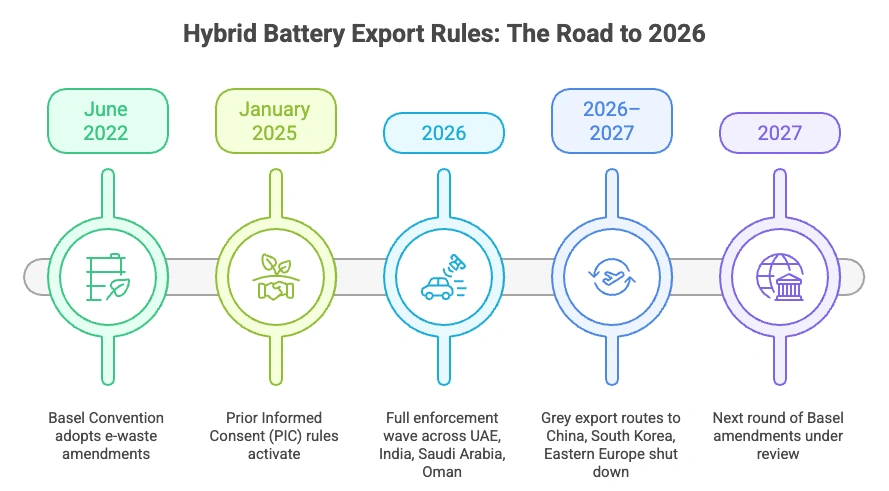
The closure of grey export routes for hybrid batteries in 2026 is driven by three forces acting together: the Basel Convention’s expanded Y49 e-waste listing capturing every cross-border movement of battery material, aggressive customs enforcement at the UAE’s Jebel Ali, India’s Nhava Sheva, and Saudi Arabia’s Jeddah ports, and new national rules requiring traceability from vehicle of origin through to licensed smelter. For collectors, workshops, and dismantlers in the region, the shift is net positive: more volume is flowing to licensed hybrid battery processors, which means better hybrid battery price transparency and fewer competitors willing to undercut on the back of illegal shipping routes.
The Basel Convention’s 2025 E-Waste Amendments
The core regulatory shift came into force on 1 January 2025, and its effects are being felt most heavily now in 2026 as enforcement catches up to legislation. According to the US Environmental Protection Agency’s guidance on the new Basel requirements, international shipments of electrical and electronic waste and scrap – including hybrid battery packs – now require prior written consent from the importing country and every transit country before the shipment can leave. This is the first time that non-hazardous e-waste has been controlled under the Basel Convention at all. For hybrid batteries, the practical effect is that every single cross-border movement now carries the same paperwork burden as a hazardous chemical shipment.
Why Hybrid Batteries Are Now a Priority Target
Hybrid batteries have become a priority for regulators because they combine fire risk during transport, recoverable high-value metals that attract informal traders, and growing volumes as Toyota, Honda, and Lexus hybrids from the 2008-2015 production wave reach end of life. Each pack contains between 8 and 12 kilograms of recoverable nickel in the NiMH case, or several kilograms of cobalt, lithium, and manganese in the Li-ion case – valuable enough to fund illegal shipments, but volatile enough to cause fires at sea or in warehouses. Understanding the expected hybrid car battery life of each pack chemistry matters here: older NiMH units from 2008-2012 vehicles are now failing in volume, creating the exact supply surge that regulators are worried about.
Price Recovery Makes Grey Shipments More Attractive – And More Targeted
Yes, metal price recovery through 2025 has increased the economic incentive for grey-route shipments, which is exactly why enforcement has intensified. As the IEA’s analysis of critical minerals in clean energy transitions shows, demand for battery metals such as nickel keeps rising as the energy transition accelerates. With nickel trading in the $15,000-$18,000 per tonne range and cobalt and lithium prices stabilising, the incentive for informal exporters to move unprocessed packs has grown – and so has the incentive for customs agencies to catch them.
What Do the New Rules Actually Require From Exporters?
Exporters must now secure Prior Informed Consent from the importing country, use UN-approved dangerous goods packaging, provide a full chain-of-custody paper trail from vehicle of origin to licensed end processor, and declare the battery chemistry accurately on every shipping document – under penalty of seizure, fines, and criminal charges.
The Basel Convention’s PIC Procedure, Explained
The Prior Informed Consent procedure is the operational backbone of the new system. Before a shipment of hybrid battery material can leave the exporting country, the exporter must notify the importing country’s competent authority in writing, receive a written consent response, and route the shipment in accordance with any conditions attached to that consent – including which port of entry is permitted and which processor the material must be delivered to. For mixed loads of nickel metal hydride battery and Li-ion packs, separate documentation may be required for each chemistry. Transit countries must also be notified and can refuse passage.
2026 Compliance Requirements at a Glance
The table below summarises the four core compliance requirements every exporter of hybrid battery material across the Middle East and South Asia must now meet.
| Requirement | What You Must Do | Penalty If Non-Compliant |
|---|---|---|
| Prior Informed Consent | Secure written consent from importing and transit countries before shipment departs | Seizure; fines; criminal charges |
| Accurate Chemistry Declaration | Declare NiMH, Li-ion, or mixed-chemistry status on shipping documents; no umbrella terms | Seizure; customs fines; loss of export licence |
| UN-Approved Packaging | Use UN 3480/3481 packaging for lithium-ion; approved alternatives for NiMH | Refusal at port; carrier and customs fines |
| Chain-of-Custody Documentation | Document origin vehicle, collection date, storage, and end processor for every pack | Permit revocation; inability to export future shipments |
Why Compliance Is Cheaper Than the Alternative
The compliance burden looks heavy on paper, but the cost of non-compliance has risen even faster. A single intercepted container of mixed hybrid battery material can now trigger fines that exceed the value of the shipment by three to five times, plus return shipping costs, plus licensing consequences. Working with a Basel-compliant partner like Recohub takes the paperwork and logistics off the collector’s desk and replaces it with a transparent, chemistry-based offer at the point of collection.
How Are Grey Export Routes Being Shut Down in Practice?
Grey export routes are being shut down through expanded customs inspection authority, better detection technology at major ports, cross-border intelligence sharing between Basel Convention signatories, and the simple fact that the new Y49 waste listing makes “it’s just used parts” a defence that no longer works at customs.
How Smuggling Networks Previously Operated
Grey route networks have historically moved hybrid battery material by disguising it as lower-risk cargo and routing it through jurisdictions with weaker enforcement. Packs were stripped of visible markings, sometimes partially disassembled, and declared as “used auto parts”, “mixed metal scrap”, or “nickel-containing industrial waste”. Consolidation hubs in the UAE and Oman would aggregate shipments and forward them to refiners in China, South Korea, and Eastern Europe. The 2025 Basel amendments specifically target this playbook by requiring chemistry declarations and origin documentation on every listed e-waste shipment, regardless of how it is packed.
Key Trade Routes and Enforcement Response
The table below outlines the main grey corridors active pre-2025 and how enforcement in 2026 is reshaping each one.
| Trade Route | Historical Grey-Route Pattern | 2026 Enforcement Response |
|---|---|---|
| UAE to China / South Korea | Consolidation at Jebel Ali; declared as “used auto parts” or “scrap metal” | Federal Customs Authority targeted inspections; mandatory chemistry declaration |
| India to China / Southeast Asia | Packs mixed with genuine auto parts at Nhava Sheva, Chennai, Mundra | CBIC risk-based container profiling; PIC documentation checks at port |
| Saudi Arabia / Oman to GCC hubs | Overland and short-sea movement to UAE consolidation points | Cross-border manifest checks under GCC customs union protocols |
What This Means for Licensed Cross-Border Operators
Licensed operators can still trade hybrid batteries across borders legally – the paperwork is demanding but entirely workable with the right processes. Recohub operates an established cross-border network across the Middle East and South Asia, with Basel-compliant documentation built into every pickup and shipment. Collectors can read more about cross-border compliance in the EU Battery Regulation section above, which covers the collector’s perspective for India, the UAE, Saudi Arabia, the USA, and Australia.
What Do the New Rules Mean for Hybrid Battery Prices and Legitimate Collectors?
The new rules are a net positive for legitimate collectors because they remove the price-undercutting pressure that grey-route exporters used to exert, concentrating volume at licensed processors and pushing up the effective hybrid car battery price paid at the collection point.
More Volume to Licensed Processors = Better Prices for Legal Sellers
When grey-route exporters are cut out of the supply chain, the volume they previously captured redirects to licensed aggregators and processors. These licensed players compete on transparent, chemistry-based pricing rather than on willingness to ignore provenance. For a workshop in Dubai or a dismantler in Mumbai, the buyer at the door in 2026 is more likely to be a licensed aggregator paying fair value than an informal broker paying 30-60% below material value.
A Double Tailwind: Regulation Meets Stable Metals Pricing
Collectors are benefiting from two tailwinds at the same time: tighter regulation channelling supply to licensed buyers, and a stable metals pricing environment after years of volatility. As the value breakdown earlier in this guide shows, a standard NiMH pack fetches $15-50 in 2026, while Li-ion NMC packs range from $30-120 depending on vehicle model and region. Toyota Prius Gen 2 and Gen 3 packs – the highest-volume unit in the regional scrap stream – currently trade in the $15-35 range, with Gen 4 Li-ion Prius packs commanding $40-90. UAE dealers typically pay 20-40% above Indian and South African rates because of better processing infrastructure.
Licensed Processor vs Informal Buyer: Side-by-Side
The difference between selling to a licensed processor and an informal buyer comes down to pricing accuracy, legal protection, and the simple question of whether your pack will reach a proper recycler.
| Factor | Licensed Processor (e.g. Recohub) | Informal / Grey-Route Buyer |
|---|---|---|
| Pricing Method | Chemistry-based, tied to live nickel/cobalt/lithium spot prices and pack weight | Visual estimate or flat “per unit” offer |
| Export Compliance | Full Basel PIC documentation from collection to end processor | No PIC; mislabelling; risk of interception |
| Typical Price Accuracy | Within 10-15% of true recoverable material value | Often 30-60% below actual value |
| Fire / Safety Handling | UN-approved transport packaging; trained handlers | Often uninsured, untrained storage |
How Can You Sell Hybrid Batteries Legally and Get the Best Price in 2026?
Sell to a licensed, Basel-compliant aggregator who uses chemistry-based pricing tied to live metals spot prices, provides full chain-of-custody documentation, and operates established legal export routes to certified end processors. If you are searching for hybrid battery recycling near me, prioritise a licensed buyer with proper export routes over the closest scrapyard, as a compliant buyer usually pays more and keeps you on the right side of the rules.
What to Expect From a Legitimate Transaction
A legitimate transaction involves weighing each pack, chemistry identification (NiMH vs Li-ion), a written receipt, and pricing based on actual recoverable material value at current spot rates. Expect to provide identification for commercial transactions – this is a compliance requirement under most jurisdictions’ hazardous waste frameworks, not a red flag. Legitimate buyers issue a written receipt detailing pack description, chemistry, weight, and price paid, with the buyer’s licence number.
Why Recohub Is Built for the New Regulatory Environment
Recohub operates as a fully licensed, Basel-compliant hybrid battery collection and export network across the Middle East and South Asia – already operating at the compliance standard the new enforcement environment demands. Recohub handles both NiMH packs from Toyota, Honda, and Lexus hybrid fleets, and lithium-ion packs from newer plug-in hybrids, with chemistry-based pricing tied to live nickel, cobalt, and lithium spot rates. Collection services are available across the region, and full compliance documentation is issued at pickup.
The 2026 wave of hybrid battery export controls across the Middle East and South Asia is not a burden for legitimate players – it is a market correction rewarding compliance, transparency, and professional collection practices. With metals prices stable, grey-route competition being shut down, and enforcement intensifying at every major port, licensed collectors and aggregators are in the strongest commercial position they have been in since hybrid battery collection became a commercial activity.
Scrap It or Sell It? How to Decide What to Do With Your Old Hybrid Battery in 2026
If your battery is still functional – even partially – explore refurbished resale or module harvesting before going straight to scrap, as you may get 2-4 times more for the same pack.
When Selling as Scrap Makes More Sense Than Refurbishing
Pure scrap is the right route when: the pack is Grade C or D (dead or damaged), the model is old enough that there is no active refurbishment demand (pre-2004 NiMH packs from discontinued models), or the cost of testing and documentation exceeds the premium a refurbisher would pay. A dead hybrid battery still has real base metal value – the decision is simply whether it has more value as scrap or as parts. In high-volume operations – dismantlers processing dozens of packs per week – the speed and simplicity of scrap pricing often outweighs the marginal gain from individual refurbishment quotes.
For individual sellers with a single pack, it is always worth getting one refurbishment quote before committing to scrap. A Grade B Prius Gen 4 pack that a dealer would buy as scrap for $45 may fetch $90-110 from a refurbisher if the SOH documentation supports it.
What to Have Ready Before Contacting a Buyer
Having the following information ready shortens the quoting process and almost always results in a better opening offer. Know the exact car model, year, and trim level – this determines battery chemistry and weight without the buyer needing to inspect. Know whether the battery was functioning when removed and how long ago it was taken out. Document any visible damage, swelling, or prior thermal events. If the battery has been tested, have the SOH percentage and voltage readings available.
UAE and UK buyers in particular often request basic documentation – especially for Li-ion packs – to confirm the pack is not subject to recall or safety notices. Preparing this upfront avoids delays.
For consolidated shipments, Recohub works with collectors across the UAE, India, South Africa, and the UK to provide competitive quotes with clear pricing by chemistry and condition grade – no vague estimates.
Get a Quote for Your Hybrid Battery
Know your model. Know your chemistry. Get a real number. Recohub buys NiMH and Li-ion hybrid batteries across the UAE, India, South Africa, and the UK – with transparent pricing by condition and chemistry, and full Basel-compliant documentation.