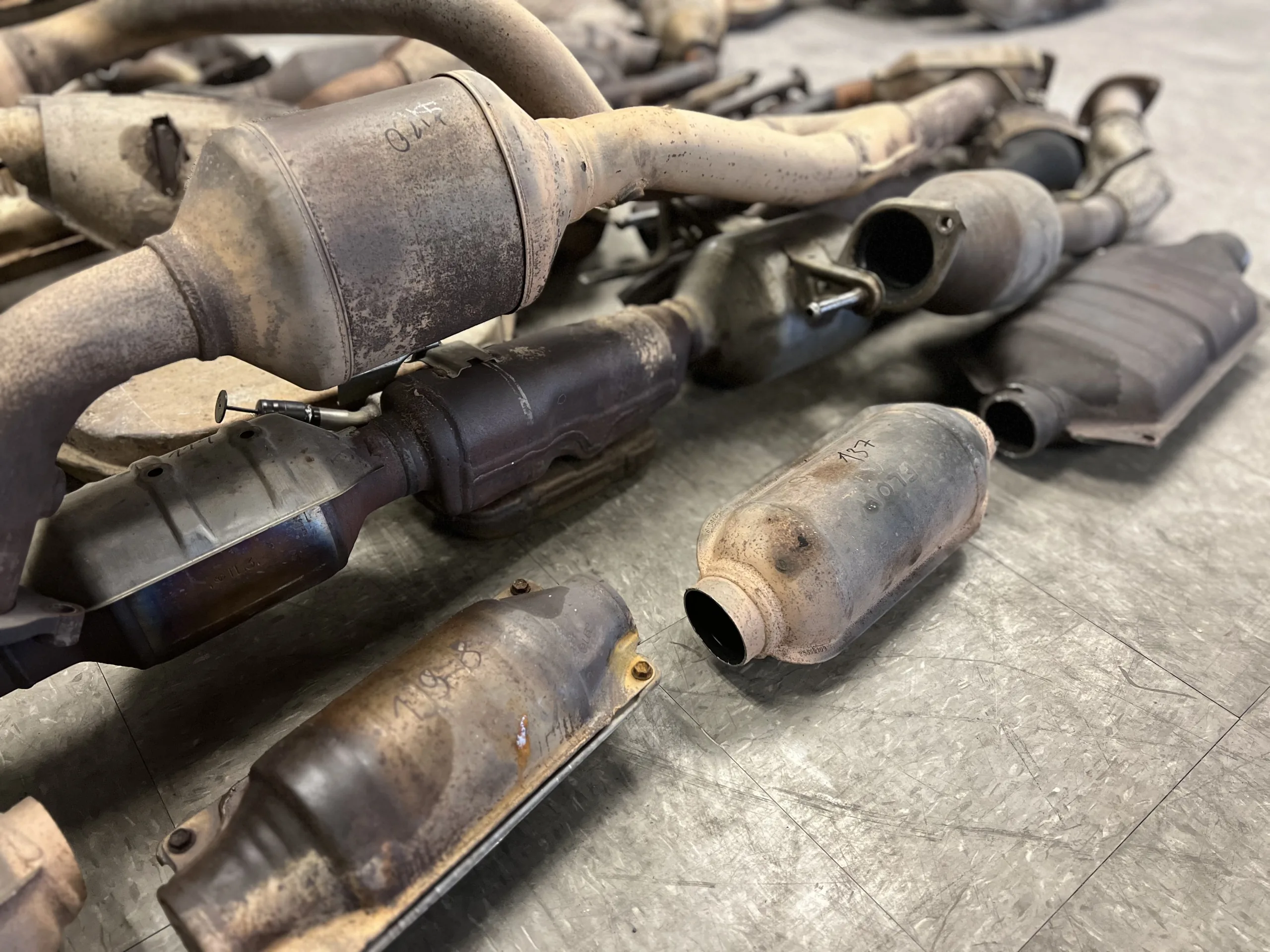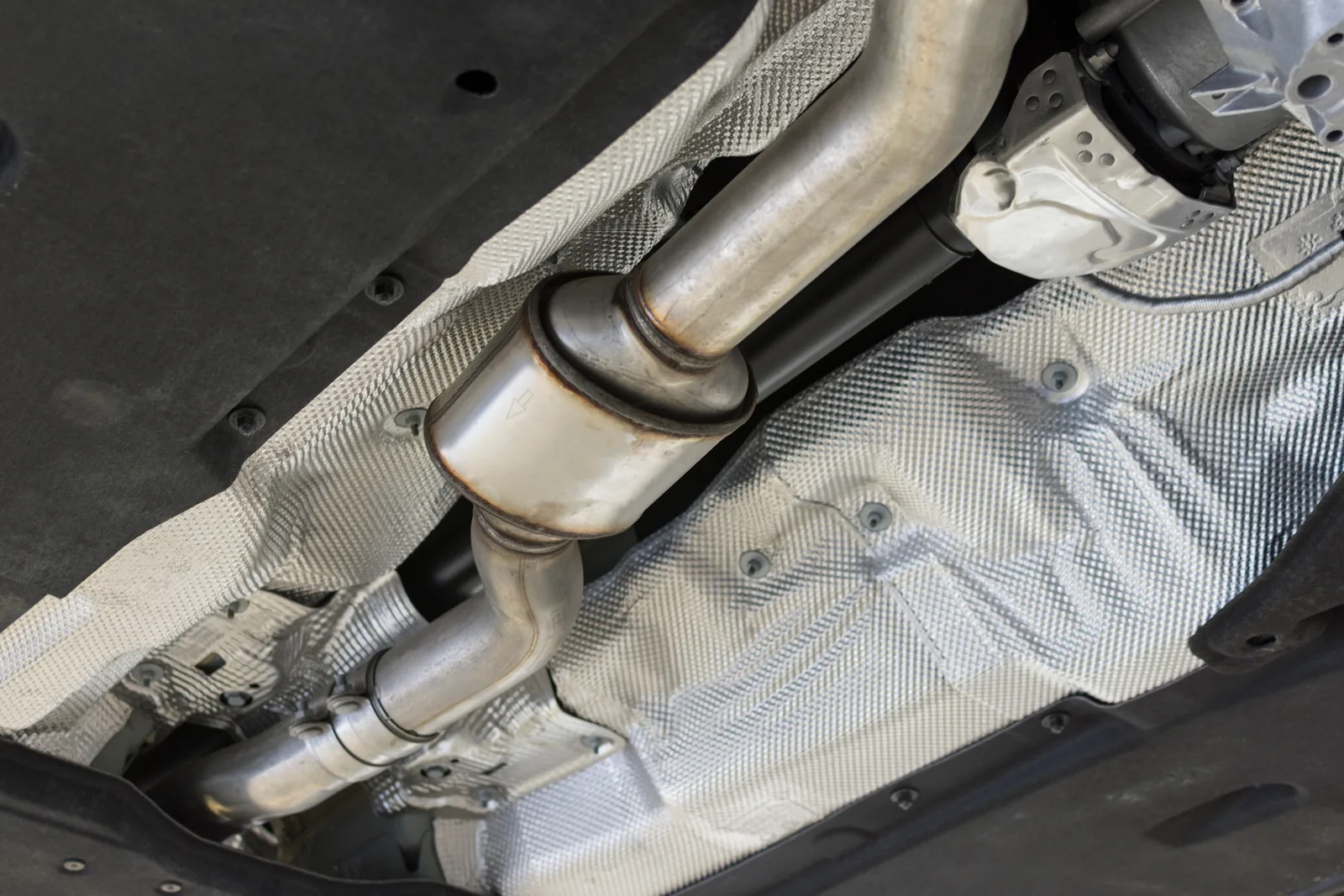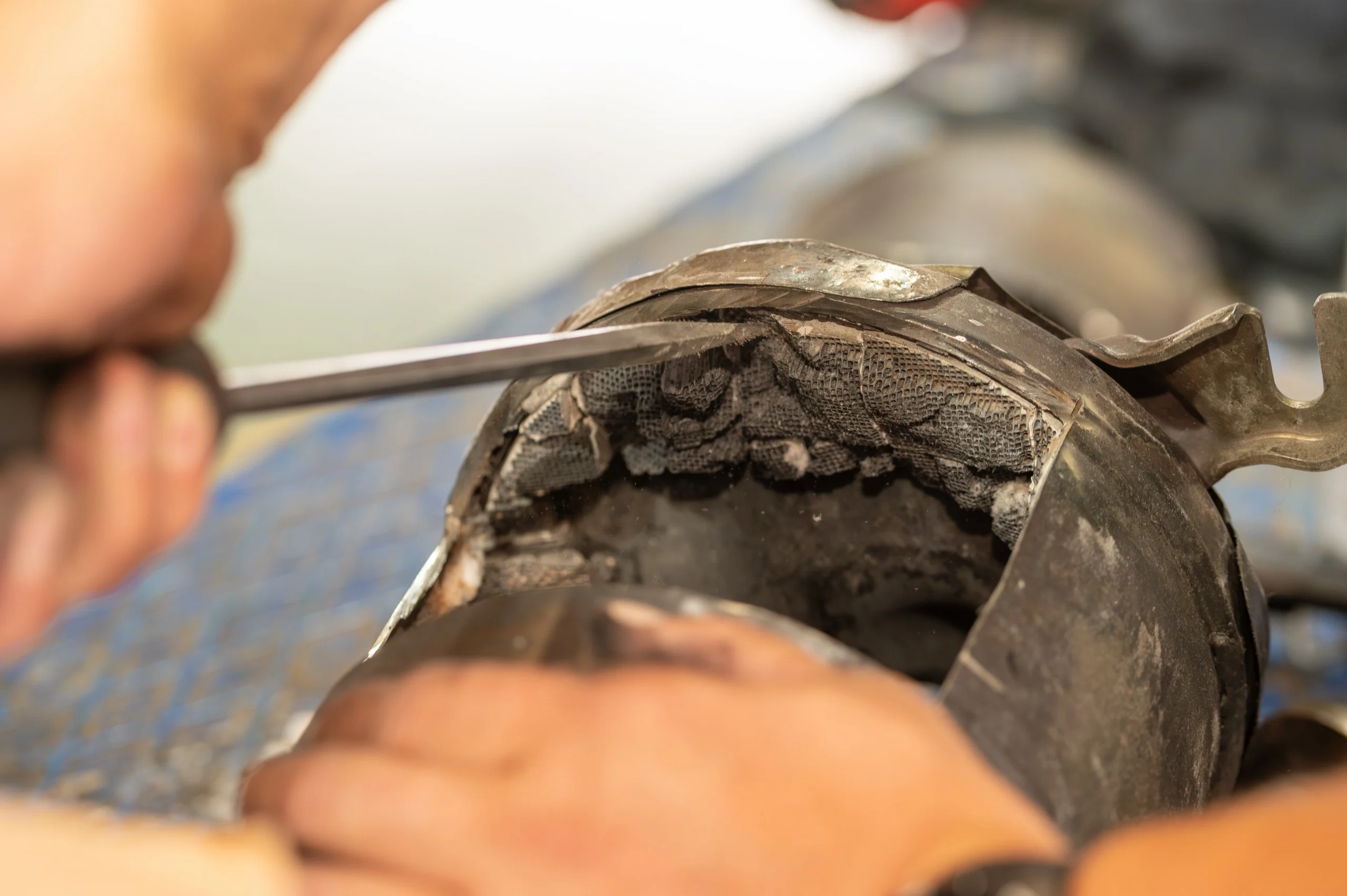

UAE, Saudi Arabia and Qatar have tightened vehicle emission enforcement in 2026, introducing new obligations for garage owners, workshops and fleet managers who remove or sell car catalytic converters. This guide explains what the new rules mean in practice, the compliance steps garages must follow, and why partnering with a licensed recycler like Recohub is the safest and most profitable path forward.
Under 2026 GCC emission rules, garage owners in UAE, Saudi Arabia and Qatar must follow regulated procedures before removing or selling an automotive catalytic converter – or face fines ranging from QAR 5,000 to AED 50,000 and potential licence revocation. Any automobile catalytic converter removed from a vehicle must pass through a licensed recycling chain. Selling to unlicensed buyers or gutting a converter to bypass emission standards is a prosecutable offence across all three countries, with penalties that can end a workshop’s operating licence overnight.
Key Takeaways
- UAE, Saudi Arabia and Qatar have all tightened emission enforcement in 2026 – garages that remove or sell catalytic converters without proper documentation face fines up to AED 50,000 / SAR 50,000 / QAR 20,000.
- Removing or gutting a car catalyst without regulatory compliance is illegal in all three GCC countries and can result in vehicle impoundment and workshop licence suspension.
- Every automotive catalytic converter contains platinum, palladium and rhodium – precious metals that must be handled through a licensed recycler under environmental waste regulations.
- Selling through a licensed recycler like Recohub protects garages legally and delivers fair market value based on actual PGM (platinum group metal) content.
- High-value auto catalyst units come from SUVs, premium brands (BMW, Lexus, Mercedes) and diesel vehicles – common across the GCC and worth significantly more than most garage owners realise.
- Stolen catalytic converter liability can fall on the garage if proper chain-of-custody documentation is not maintained from removal to recycler handover.
What UAE, Saudi Arabia and Qatar’s 2026 Emission Rules Actually Mean for Garage Owners
The Regulatory Framework Behind the 2026 Rules
The 2026 emission rule tightening across the GCC means that garages handling car catalytic converters are now subject to stricter documentation requirements, environmental waste obligations and vehicle modification laws – with enforcement that has materially intensified compared to previous years. All three countries have been progressively aligning their vehicle emission standards with Euro 5 and Euro 6 equivalents, driven by national sustainability agendas. Saudi Arabia’s SASO (Saudi Standards, Metrology and Quality Organisation) adopted Euro 5 equivalent standards for new vehicles, while the UAE’s Roads and Transport Authority (RTA) enforces emission testing as part of mandatory vehicle inspection. Qatar’s Ministry of Environment and Climate Change oversees compliance under the National Vision 2030 environmental pillar. The UNECE’s Global Technical Regulations (WP.29) form the international backbone that all three countries reference in their standards framework.Why Catalytic Converters Are Now Classified as Regulated Waste
For garage owners, the practical implication is clear: a catalytic converter is no longer just a metal component you remove and set aside. It is classified as environmental waste containing regulated precious metals – platinum (2-7g per unit), palladium (2-7g) and rhodium (0.5-2g) – and its handling from the moment of removal is subject to law. Research by the International Council on Clean Transportation (ICCT) confirms that GCC countries are accelerating enforcement of emission-related regulations as part of their broader energy transition commitments. Gutting a converter – drilling out the internal substrate to reduce exhaust back-pressure while bypassing emission filtering – is treated as deliberate environmental fraud in all three countries, and carries the harshest penalties. Even unintentional non-compliance, such as selling a removed automobile catalytic converter to an unlicensed buyer without documentation, creates serious legal exposure for the workshop owner.How Enforcement Has Changed Operationally in 2026
It is also worth understanding what the 2026 tightening looks like operationally. In the UAE, Tasjeel and Wasel vehicle inspection centres now flag emission system anomalies – including missing or non-functional catalytic converters – in real time, with alerts passed to the RTA enforcement database. Any vehicle registered to a UAE workshop that repeatedly fails emission checks creates a pattern of record that investigators can use. Saudi Arabia’s Fahes inspection network performs a similar function, and since 2025 has been cross-referencing workshop service records against inspection outcomes as part of the NCEC’s broader environmental compliance programme. Qatar introduced mandatory roadside emission spot checks in late 2025, meaning non-compliant vehicles are now at risk of enforcement outside of scheduled inspection windows.What This Means for Fleet Operators and Their Garages
For fleet operators – companies running 10 or more vehicles in the UAE, Saudi Arabia or Qatar – the compliance burden is compounded by fleet-level audits. Fleets are required to maintain service records demonstrating that every removed car catalytic converter was handled in accordance with current regulations. Garages that service fleet accounts without maintaining this documentation risk losing the contract if the fleet operator is audited. The safest, most commercially rational route is to partner with a licensed recycler. Recohub operates as a regulated precious metals and auto catalyst recycler across the GCC and South Asia, providing compliant purchase documentation, full chain-of-custody records, and fair PGM-based pricing for every unit.Step-by-Step Compliance Checklist for Garages in UAE, Saudi Arabia and Qatar
A GCC garage must verify vehicle ownership documentation, record the VIN and converter details, issue a workshop receipt, and transfer the unit only to a licensed recycler – before removing or selling any catalytic converter in UAE, Saudi Arabia or Qatar. Missing any of these steps creates direct legal exposure under each country’s vehicle modification and environmental waste laws. The following checklist applies regardless of whether the garage is replacing a faulty converter, conducting a full engine service, or preparing a vehicle for sale. It is structured in the order a workshop manager would execute it.Step 1 – Verify Vehicle Ownership Before Any Work Begins
Action: Check ownership documents
Request the vehicle’s registration document. In UAE this is the Mulkiya; in Saudi Arabia, the Istimara; in Qatar, the vehicle registration card issued by the Ministry of Interior. Confirm the customer’s Emirates ID, Iqama or QID matches. Do not proceed if documents cannot be produced.
Step 2 – Record the Vehicle Identification Number (VIN) and Converter Details
Action: Log VIN and physical converter details
Note the VIN from the vehicle chassis plate (not only the registration document). Photograph the catalytic converter in situ before removal. Record any serial numbers stamped on the converter casing. This creates the traceability chain that protects the garage if the vehicle is later flagged in a theft investigation.
Step 3 – Issue a Workshop Receipt with Full Description
Action: Document the removal formally
Issue a written workshop order describing the removal, the reason (replacement, end-of-life, vehicle deregistration), the customer’s details and the vehicle’s VIN. Retain a signed copy. This document is required by enforcement officers in all three countries if the garage is inspected.
Step 4 – Store the Converter Correctly Pending Transfer
Action: Label and secure the unit
Label each removed car catalytic converterwith the VIN, removal date, and customer name. Store in a designated secure area, separate from general scrap. Do not mix multiple units unlabelled – this is a common compliance failure during routine inspections.
Step 5 – Transfer Only to a Licensed Recycler
Action: Arrange handover to a licensed PGM recycler
Contact a licensed recycler such as Recohub for collection or drop-off. Request a purchase receipt that includes the recycler’s licence details, the unit count, weight and transaction reference. File this document with the original workshop receipt. This completes the chain of custody and is your primary legal defence.
For a full walkthrough of the selling process, see Recohub’s complete legal guide to selling catalytic converters in the Middle East and South Asia.
| Country | Regulatory Body | Key Requirement | Documentation Needed |
|---|---|---|---|
| UAE | RTA / Ministry of Climate Change & Environment (MoCC) | Converter removal must be logged; sale only to licensed recycler; vehicle must pass Tasjeel/Wasel emission test after replacement | Mulkiya, Emirates ID, workshop order, licensed recycler receipt |
| Saudi Arabia | SASO / National Centre for Environmental Compliance (NCEC) | Garage must maintain removal logs; converters classified as hazardous waste; vehicle must pass Fahes inspection post-service | Istimara, customer Iqama, signed removal authorisation, NCEC-licensed recycler transfer note |
| Qatar | Ministry of Environment and Climate Change | Converter disposal subject to environmental waste rules; vehicle must pass mandatory Fahes inspection with functional converter or certified replacement | Vehicle registration card, QID, workshop receipt, licensed recycler handover document |
Penalties and Fines for Illegal Catalytic Converter Removal or Gutting in UAE, Saudi Arabia and Qatar
The fine for illegally removing or gutting a catalytic converter in the UAE reaches AED 50,000; in Saudi Arabia, SAR 50,000; and in Qatar, between QAR 5,000 and QAR 20,000 – with vehicle impoundment, licence suspension and workshop closure among the additional consequences in each country.UAE
The UAE Ministry of Climate Change and Environment (MoCC) classifies the removal, gutting or bypass of a catalytic converter as an illegal vehicle modification. The RTA enforces this through mandatory vehicle inspection at Tasjeel and Wasel centres. A vehicle presenting without a functioning converter will fail inspection and cannot be renewed or transferred. Fines for illegal modification reach AED 50,000, and repeat offences can result in the garage’s operating license being suspended or revoked. Impoundment of the vehicle is standard procedure while the case is investigated.Saudi Arabia
SASO and the National Centre for Environmental Compliance (NCEC) jointly oversee garage compliance in Saudi Arabia. Gutting an automotive catalytic converter or selling one without proper documentation is classified as both an illegal vehicle modification and an environmental offence. Fines reach SAR 50,000 for a single offence, with repeat violations triggering workshop license suspension and possible criminal referral. All vehicles must pass the Fahes emission inspection; a missing or non-functional converter is an automatic failure. Saudi Arabia’s Vision 2030 environmental targets have accelerated enforcement activity across the automotive sector since 2024.Qatar
Qatar’s Ministry of Environment and Climate Change enforces vehicle emission compliance in line with National Vision 2030 commitments. Garages found selling or gutting converters without documentation face fines of QAR 5,000-20,000. Vehicles that fail the mandatory Fahes inspection due to a missing or damaged converter cannot legally operate on Qatari roads until the defect is rectified and re-inspected. Qatar has significantly intensified roadside emission checks in 2025-2026, making non-compliant vehicles a practical enforcement target even outside of scheduled inspection windows.What Happens After a Fine Is Issued
Across all three countries, the fine itself is rarely the end of the matter for a non-compliant garage. In the UAE, a single violation can trigger a formal compliance audit of the entire workshop – inspectors will review removal records, storage practices and recycler relationships for all recent transactions, not just the incident that prompted the initial fine. In Saudi Arabia, NCEC follow-up inspections have become standard procedure within 60 days of any environmental violation finding. Repeat offenders in all three markets face escalating consequences: licence suspension for a first repeat, and permanent revocation on a second. For a workshop owner who has invested years building a client base, the reputational and financial cost of licence revocation far exceeds any short-term gain from cutting corners on a car catalyst disposal. The economics of compliance – partnering with a licensed recycler like Recohub, maintaining proper records, following the documented SOP – are straightforwardly better than the alternative.| Country | Offence | Minimum Fine | Maximum Fine | Additional Consequence |
|---|---|---|---|---|
| UAE | Illegal removal / gutting / sale without documentation | AED 10,000 | AED 50,000 | Vehicle impoundment; garage licence suspension |
| Saudi Arabia | Environmental offence + illegal vehicle modification | SAR 10,000 | SAR 50,000 | Workshop closure; criminal referral for repeat offences |
| Qatar | Non-compliant disposal / illegal modification | QAR 5,000 | QAR 20,000 | Fahes inspection failure; vehicle off-road order |
⚠️ Important note on gutting: Drilling out or mechanically destroying the internal substrate of an automobile catalytic converter to reduce back-pressure while retaining the converter casing is treated as deliberate environmental fraud in all three countries – not merely a technical modification. Enforcement officers are trained to identify gutted converters during inspection. The penalties for this specific offence tend to fall at the maximum end of the fine scale.
Standard Operating Procedure (SOP) for Safe Catalytic Converter Removal in GCC Workshops
The correct SOP for removing a catalytic converter in a UAE or Saudi garage begins with verifying vehicle documentation, then safely disconnecting the unit with appropriate protective equipment, labelling it immediately with the VIN and removal date, and arranging transfer to a licensed recycler – all documented at each stage. Following a written SOP is not only a regulatory best practice – it is increasingly a requirement for workshop licence renewal in UAE and Saudi Arabia. Workshops that cannot demonstrate a documented procedure for handling auto catalyst units during compliance audits face increased scrutiny.Why Documentation Also Protects Your Insurance Position
There is also an insurance dimension that many garage owners overlook. If a vehicle owner makes an insurance claim and the insurer’s investigation finds that the workshop removed an emissions component without proper documentation, the claim can be voided – and the garage held liable for the vehicle owner’s losses. Documenting every removal is therefore not only a regulatory obligation but a direct protection against civil liability claims that can far exceed the value of any individual automotive catalytic converter.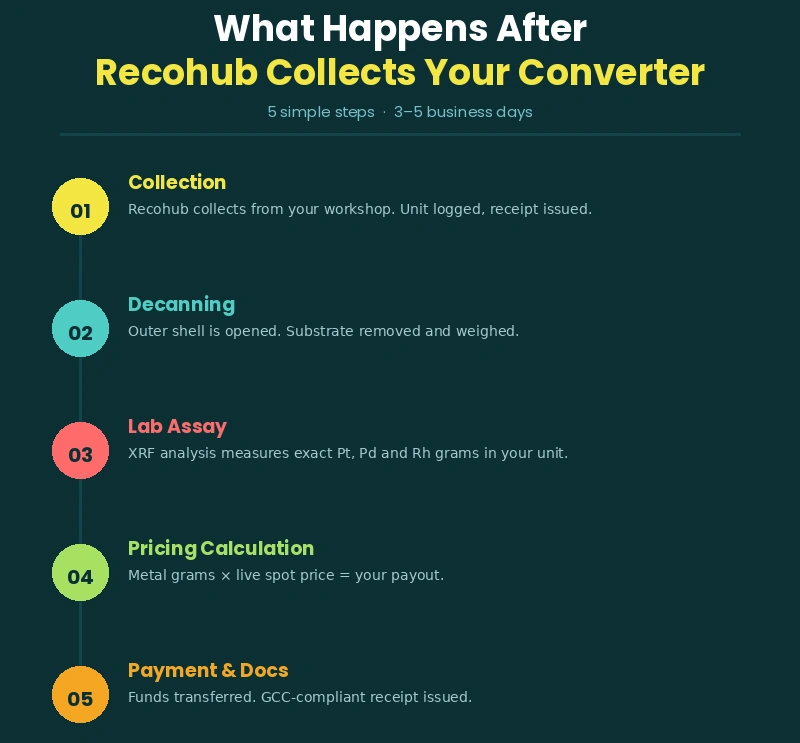
Health and Safety Before Removal
Catalytic converters operate at temperatures of 400-800°C during normal use. Always allow a minimum of 90 minutes after the engine has been switched off before beginning removal work. Wear heat-resistant gloves and protective eyewear. When cutting or grinding near the converter casing, PGM-bearing dust can be released – respiratory protection (minimum FFP2 standard) is recommended. Never use power tools to deliberately fracture or grind the internal substrate.Removal Procedure
Raise the vehicle on a certified lift and secure with safety stands. Loosen and remove the bolted flanges connecting the converter to the exhaust manifold (upstream) and the intermediate pipe (downstream). If the converter is welded, use a pipe cutter to section at a point that preserves the converter body intact for accurate assay. Avoid crushing or deforming the casing – damage reduces the accuracy of PGM recovery and therefore the price offered by the recycler.Labelling and Secure Storage
Immediately upon removal, attach a tag to the converter stating the VIN, vehicle make and model, removal date, and the name of the technician. Place in a lockable storage cage or cabinet designated for catalytic converters. Do not mix unlabelled units – this is a source of both compliance risk and commercial loss, as mixed, unlabelled converters may be valued at the lowest-grade rate.| Step | Action | Documentation Required | Responsible Party |
|---|---|---|---|
| 1 | Verify ownership documents before work begins | Mulkiya / Istimara / Registration card + customer ID | Service advisor / workshop manager |
| 2 | Photograph converter in-situ, record VIN | Photographic record + VIN log entry | Assigned technician |
| 3 | Allow cooldown period (min. 90 mins), apply PPE | Safety checklist signature | Assigned technician |
| 4 | Remove converter, keep casing intact | Workshop job card updated | Assigned technician |
| 5 | Label unit with VIN, date, technician name | Physical tag + internal inventory log | Assigned technician |
| 6 | Store in locked, designated area | Storage log entry | Workshop manager |
| 7 | Contact licensed recycler (e.g. Recohub) for collection | Collection booking confirmation | Workshop manager |
| 8 | Handover and receive purchase receipt | Licensed recycler receipt with licence number, unit count, weight, value | Workshop manager / owner |
How Garages Can Protect Themselves from Handling Stolen Catalytic Converters in UAE, Saudi Arabia and Qatar
A GCC garage can avoid unknowingly buying or handling a stolen catalytic converter by always verifying vehicle ownership documents before accepting any unit, cross-referencing the VIN against the converter, and transferring exclusively through licensed recyclers who maintain traceable records.Why Converter Theft Has Surged Across the GCC
Catalytic converter theft has become one of the fastest-growing vehicle crimes in the Gulf region, increasing over 300% between 2020 and 2024. The driver is simple: high platinum, palladium and rhodium prices make a single converter worth hundreds of dollars on the open market – and thieves can remove a converter from an unattended vehicle in under three minutes with basic tools. To understand why PGM values remain elevated in 2026, see how the 2026 regional instability is affecting scrap catalytic converter prices in the Gulf and South Asia.The Legal Liability Risk for Garages
The legal risk for garages is significant. Under UAE, Saudi and Qatari law, knowingly or negligently receiving stolen property creates criminal liability – and enforcement officers investigating converter theft increasingly follow the chain to the last point of sale. A garage that purchased a stolen car catalyst from a walk-in customer without documentation can face prosecution even if they paid a fair price in good faith, because the absence of documentation is itself treated as negligence.Practical Protection Steps
Always require the vehicle owner to be present when accepting a converter brought in separately – or require proof that the converter was removed at your own workshop with full paperwork. Never accept a converter from an unknown individual who arrives without the vehicle. Verify that the VIN stamped or etched on the converter casing (where present) matches the vehicle registration documents. Maintain a purchase log for every unit that enters your workshop, and retain it for a minimum of two years. Working with a licensed recycler such as Recohub adds a further layer of protection: every transaction generates a compliant purchase record that demonstrates due diligence. In the event of a later investigation, this documentation is the clearest evidence that your workshop handled the unit in good faith through a regulated channel.What to Do If You Suspect a Unit May Be Stolen
If a converter is presented to your workshop and you have doubts about its origin, do not purchase it and do not return it to the individual without recording their details. In UAE, you should contact the RTA or local police non-emergency line to report a suspicious transaction. In Saudi Arabia, contact the nearest NCEC office or Absher-linked complaint channel. In Qatar, the Ministry of Environment and Climate Change operates a compliance hotline for environmental waste concerns. Document everything: the time, the individual’s description, any vehicle they arrived in, and the physical details of the converter. Reporting a suspicious unit is not only the legally correct action – it actively protects your workshop from any subsequent accusation of knowingly receiving stolen property. Garages that proactively report suspicious transactions have, in documented GCC cases, been treated as cooperative witnesses rather than suspects.🚨 Red Flags – Decline Any Unit That Shows These Signs
- No vehicle present – the seller arrives with a bare converter and no vehicle
- No ownership documents – seller cannot produce a Mulkiya, Istimara or registration card
- ID mismatch – customer ID does not match the vehicle registration
- Fresh cuts on the exhaust pipe – indicating rapid removal rather than a workshop procedure
- Multiple converters offered at once by a non-trade individual
- Seller is reluctant to provide contact details or wait for documentation to be completed
- Converter casing shows drill marks or impact damage (possible gutting or hasty removal)
- Significantly below-market asking price – often indicates stolen origin
Top 10 Car Models in UAE, Saudi Arabia and Qatar with the Most Valuable Catalytic Converters in 2026
In 2026, the most valuable catalytic converters in the GCC come from the Toyota Land Cruiser, Lexus GX and LX, BMW 5-Series and X5, Nissan Patrol, and Mercedes-Benz GLE and GLS – all large-displacement vehicles dominant in the UAE, Saudi Arabia and Qatar that carry exceptionally high platinum group metal loadings.Why GCC Vehicles Carry Higher PGM Loadings Than the Global Average
The value of any automobile catalytic converter is determined by the weight and purity of the platinum (Pt), palladium (Pd) and rhodium (Rh) it contains. Larger engines require greater catalytic capacity, which means more PGM loading per unit. With platinum trading at approximately $950-1,050/troy oz, palladium at $980-1,100/troy oz, and rhodium at $4,500-6,000/troy oz in 2026, even a mid-range SUV converter represents a significant recoverable asset. The GCC market is dominated by large-engine vehicles – Land Cruisers, Patrols and American SUVs are daily-driver staples in ways not seen in European or Asian markets. This means the average converter value per vehicle in the UAE and Saudi Arabia is meaningfully higher than the global average. A bmw converter from a 5-Series or X5 in Dubai or Riyadh, for example, can contain $400-$900 in recoverable metals depending on the model year and engine variant.The 10 Models Worth the Most in the GCC in 2026
How to Use This Information to Maximise Workshop Revenue
For a garage owner, understanding which vehicles carry the highest-value converters has a direct commercial implication: it determines how you negotiate with customers, how you price replacement services, and how you prioritise collection runs with your recycling partner. A workshop that services a fleet of Toyota Land Cruisers, for instance, is sitting on considerably more recoverable PGM value per service than one focused on small passenger cars. Communicating this clearly to fleet clients – that the removed automobile catalytic converter has real monetary value and will be properly handled – can itself become a competitive differentiator when pitching for fleet service contracts.| Vehicle Model | Engine Type | Approx. PGM Content | Est. Converter Value (USD) | Prevalence in GCC |
|---|---|---|---|---|
| Toyota Land Cruiser 200 / 300 | 4.5L / 3.5L V6 Petrol | Pt: 4-6g, Pd: 5-7g, Rh: 1-2g | $550 – $900 | Extremely high |
| Toyota Prado 150 | 4.0L V6 Petrol | Pt: 3-5g, Pd: 4-6g, Rh: 0.8-1.5g | $400 – $700 | Very high |
| Nissan Patrol Y62 | 5.6L V8 Petrol | Pt: 4-6g, Pd: 5-8g, Rh: 1-2g | $500 – $850 | Very high |
| BMW 5-Series / X5 (bmw converter) | 3.0L – 4.4L Petrol / Diesel | Pt: 3-6g, Pd: 4-7g, Rh: 0.8-1.8g | $400 – $900 | High |
| Lexus GX 460 / LX 570 | 4.6L / 5.7L V8 Petrol | Pt: 4-7g, Pd: 5-8g, Rh: 1-2g | $550 – $950 | High |
| Mercedes-Benz GLE / GLS | 3.0L – 4.0L Petrol / Diesel | Pt: 3-5g, Pd: 4-6g, Rh: 0.7-1.5g | $380 – $750 | High |
| GMC Yukon / Chevrolet Tahoe | 5.3L / 6.2L V8 Petrol | Pt: 3-5g, Pd: 4-7g, Rh: 0.8-1.6g | $420 – $780 | Moderate-high |
| Cadillac Escalade | 6.2L V8 Petrol | Pt: 4-6g, Pd: 5-7g, Rh: 1-1.8g | $480 – $820 | Moderate |
| Porsche Cayenne | 3.0L – 4.0L Petrol | Pt: 3-5g, Pd: 4-6g, Rh: 0.8-1.5g | $400 – $720 | Moderate |
| Honda Accord / Toyota Camry | 2.0L – 2.5L Petrol | Pt: 2-4g, Pd: 3-5g, Rh: 0.5-1g | $150 – $400 | Very high (fleet) |
Note on PGM values: All value estimates are based on 2026 spot prices (Pt ~$1,000/oz, Pd ~$1,050/oz, Rh ~$5,000/oz) and typical PGM loadings for these models. Actual recovery depends on the substrate condition, model year, and whether the unit has been pre-treated. Recohub assays every unit individually – so you receive the actual value of your specific converter, not a generic estimate.