
Overview: This guide explains what the converter in your exhaust does, where it sits on different vehicles, how the car’s onboard diagnostics decide that it is failing, what a replacement costs, and what sets the value of an old unit when it is sold for recycling. Each section links to a more detailed Recohub article.
Key Takeaways
- The converter is an emissions control device that turns carbon monoxide, unburnt hydrocarbons and nitrogen oxides into carbon dioxide, water and nitrogen. According to the Science History Institute, today’s three-way units can convert as much as 98% of these gases.
- It sits under the vehicle, in the exhaust between the exhaust manifold and the muffler, usually as close to the engine as the layout allows.
- Onboard diagnostics compare oxygen sensors before and after the unit and turn on the warning light once emissions would exceed 1.75 times the HC or NOx standard.
- P0420 is the code most often linked to a weak converter, but misfires, oil burning or a faulty sensor can cause it too.
- AAA puts a full replacement at $1,000 to $4,000 for parts and labor; in California, an aftermarket unit needs a CARB Executive Order.
- Scrap value depends on the platinum, palladium and rhodium inside, which ranges from about 1-2 grams in a small car unit to 12-15 grams in a big truck unit.
- Keep an old unit intact and get a quote based on the code stamped on its shell.
A catalytic converter is the emissions control device built into a vehicle’s exhaust. Inside a metal shell, a honeycomb coated with platinum, palladium and rhodium turns the most harmful exhaust gases into less harmful ones before they reach the tailpipe. It has no moving parts, it works only once it is hot, and on almost every gasoline car built since the mid-1970s it is one of the most valuable parts under the vehicle.
That value works in two directions. When the unit fails, the catalytic converter price for a replacement can be one of the bigger repair bills a driver faces. When it comes off the car, the catalytic converter scrap price reflects the precious metal still in its coating.
This guide connects the two: how the device works, where to find it, how the car diagnoses a fault, what a replacement costs and what an old unit is worth.
Each section answers one question and points to a deeper Recohub article on that subject, so you can read from start to finish or jump straight to the part you need.
What does a catalytic converter do?
It turns three harmful gases into less harmful ones. A gasoline engine produces carbon monoxide, unburnt hydrocarbons and nitrogen oxides, and the converter deals with all three at the same time through two kinds of chemical reaction.
- Oxidation adds oxygen to carbon monoxide and hydrocarbons, turning them into carbon dioxide and water.
- Reduction removes oxygen from nitrogen oxides, leaving nitrogen.
The precious metals speed up both reactions without being used up, which is why a converter can keep working for many years. According to the Science History Institute, today’s three-way devices can convert as much as 98% of these three gases into less harmful ones.
| Gas | Where it comes from | Reaction | What comes out | Main metal |
|---|---|---|---|---|
| Carbon monoxide (CO) | Incomplete combustion | Oxidation | Carbon dioxide | Platinum, palladium |
| Hydrocarbons (HC) | Unburnt fuel | Oxidation | Carbon dioxide and water | Platinum, palladium |
| Nitrogen oxides (NOx) | Nitrogen and oxygen reacting in the hot combustion chamber | Reduction | Nitrogen | Rhodium |
Source: Chemistry LibreTexts; Royal Society of Chemistry.
A three-way unit only works this well when the engine keeps its air-fuel mixture close to the ideal ratio. With too much oxygen, nitrogen oxides are not reduced; with too little, carbon monoxide and hydrocarbons are not fully oxidized. That is why the oxygen sensors around the converter matter so much, as the diagnostics section below explains.
Diesels split the job. According to the U.S. Department of Energy’s Alternative Fuels Data Center, a modern diesel uses a diesel oxidation catalyst and a diesel particulate filter, then adds diesel exhaust fluid ahead of a selective catalytic reduction unit that reduces nitrogen oxides. For a deeper look at the device and why it matters for air quality, read our explainer on how converters work and their environmental impact.
Inside a catalytic converter: shell, honeycomb and precious metals
Every unit is built from the same basic layers, and the valuable one is the thinnest.
| Layer | What it is | What it does |
|---|---|---|
| Shell | Metal housing with inlet and outlet pipes | Holds the parts together and connects to the exhaust |
| Support mat | Heat-resistant mat around the honeycomb | Holds the honeycomb in place and cushions it |
| Honeycomb (substrate) | Ceramic or metal foil block with many thin channels | Creates a large surface for the gas to flow over |
| Washcoat | Porous aluminum oxide layer on the channel walls | Multiplies the surface area and holds the precious metals |
| Precious metals | Platinum, palladium and rhodium | Drive the oxidation and reduction reactions |
Source: Science History Institute; Chemistry LibreTexts.
The Science History Institute notes that the honeycomb structure vastly increased the surface area of catalyst that comes into contact with the exhaust. The metals are scarce as well as effective: the Royal Society of Chemistry notes that converters for cars, trucks and buses account for about half of annual platinum demand, and that about 80% of rhodium is used in car catalytic converters.
Where is the catalytic converter located?
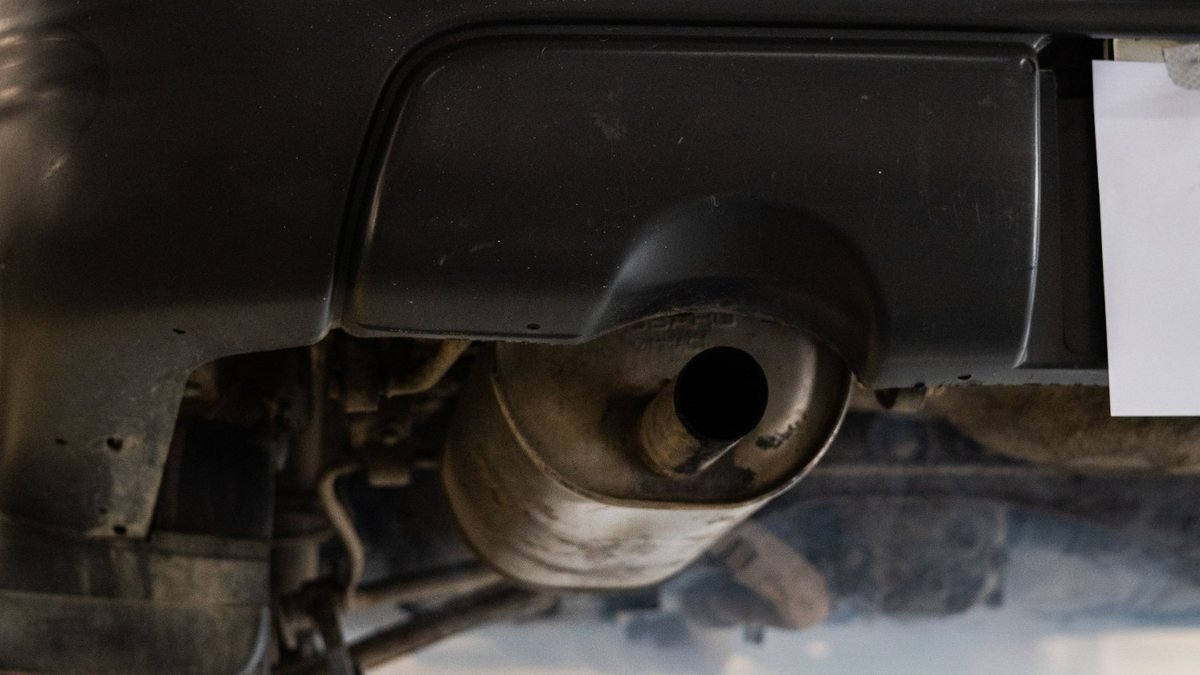
Where is the catalytic converter located? Under the vehicle, as part of the exhaust. Gas leaves the engine through the exhaust manifold, passes through the converter, then travels through the muffler to the tailpipe. Because the unit only cleans the gas properly once it is hot, manufacturers place it as close to the engine as the layout allows.
Many modern gasoline cars have a small converter right after the exhaust manifold and a second, larger unit further back under the floor. Engines with two banks of cylinders can have a converter on each side. The easiest clue is the oxygen sensors: on a gasoline car there is usually one in front of the converter and one behind it.
| Vehicle type | Where the converter usually sits | What to know |
|---|---|---|
| Gasoline car | Right after the exhaust manifold, sometimes with a second underfloor unit | The front unit can be hidden behind the engine or a heat shield |
| Diesel car or truck | Close to the engine, followed by a particulate filter and often an SCR unit | Several emission parts in the same area can look alike |
| Hybrid | Under the car, in the exhaust, as on a gasoline car | Often among the more valuable units for recyclers |
| Pickup, SUV or van | Under the vehicle, with more ground clearance | Easier to see and easier to reach |
| Fully electric car | None | No exhaust, so no converter |
Source: U.S. Department of Energy, Alternative Fuels Data Center; Kelley Blue Book; NICB.
That exposed position has a downside. The National Insurance Crime Bureau notes that a converter can be removed in just a few minutes, and that replacing a stolen one can cost between $1,000 and $3,500 or more.
Converters also turn up well beyond cars, on trucks, buses, motorcycles, generators and some marine engines. Our full guide to every place converters turn up covers each source and how to check a vehicle safely.
How to check where it sits on your own vehicle
If you want to confirm where is the catalytic converter located on your own car, start at the engine and follow the exhaust back. Do it with the vehicle parked on level ground, the engine off and the exhaust fully cold, and use a flashlight from the side rather than crawling underneath.
- Find the point where the exhaust leaves the engine: the exhaust manifold or the downpipe.
- Follow the pipe back until it widens into an oval or round metal canister, often under a thin heat shield.
- Look for the oxygen sensors, small threaded plugs with wires screwed into the pipe before and after the canister.
- Check for a second canister further back under the floor, before the muffler.
Never get under a vehicle that is held up only by a jack. If you need a closer look, ask a repair shop to check it on a lift.
Why the location makes it a theft target
Because the unit sits under the vehicle, pickups, SUVs and vans with high ground clearance are the easiest to reach. Thefts have fallen from their peak: according to NICB data reported by Consumer Reports, roughly 14,000 converters were stolen in 2024, a 68% decrease from 2023, and nearly two-thirds of the thefts reported to the NICB that year were in California.
The risk has not gone away, though, and higher metal prices tend to bring it back. The NICB advises parking in well-lit areas or areas monitored by cameras, fitting an anti-theft guard over the converter and etching the vehicle identification number onto it.
How does a car know a catalytic converter is failing?
It compares two oxygen sensors. The front sensor measures oxygen in the exhaust before the converter so the engine computer can keep the mixture on target. The rear sensor measures it after the converter. A healthy unit stores and releases oxygen, so the rear signal stays steadier than the front one.
A California Air Resources Board OBD overview explains the rule behind the warning light. The system uses oxygen storage to infer how well the converter is cleaning hydrocarbons, and it is calibrated to turn on the malfunction indicator light and store fault information once performance drops to the point where emissions would exceed 1.75 times the HC or NOx standard.
In CARB’s worked example for code P0420, the monitor compares the switching of the rear sensor with the front sensor, runs once per trip and needs two trips before the light comes on.
That makes P0420 the code most often linked to a weak converter, but it does not always mean the converter has failed. A misfire, an engine burning oil, an exhaust leak or a faulty sensor can all trigger it. Our article on why that one fault code turns up in so many shops walks through how a technician rules each cause in or out.
What a technician checks before replacing it
A good diagnosis looks at the whole system, not just the code. When the OBD system flags a fault, it stores a fault code and a freeze frame, a snapshot of conditions such as engine speed and load at the moment the fault was detected, as the CARB overview describes. A technician will usually:
- read all stored codes and the freeze frame data, not just P0420;
- check for misfire codes, fuel trim problems and oil or coolant consumption;
- compare live readings from the front and rear oxygen sensors with the engine warm;
- look for exhaust leaks ahead of the rear sensor, which can upset its readings;
- inspect the unit for dents, a loose rattling core or signs of overheating.
Replacing the converter without this check is the most expensive way to find out the real fault was a sensor or a misfire.
Check engine light with P0420: is it really the converter?
Symptoms and sounds of a failing unit
The most common signs that a catalytic converter is in trouble are:
- the check engine light, often with P0420 or P0430 stored;
- a rattle from under the car, which can mean the honeycomb has broken up;
- a rotten-egg smell from the exhaust;
- sluggish acceleration or poor fuel economy, which can point to a blockage;
- a failed emissions inspection.
A converter rarely fails on its own. Unburnt fuel from misfires can overheat it, and oil or coolant burning in the engine can coat it, so the root cause should be fixed before a new unit goes on. Our guide to the warning signs and the sounds to listen for explains what each noise usually means.
Can a converter be cleaned?
Sometimes. A fuel additive or a long drive at steady highway speed may help with light deposits on a unit that is otherwise sound.
Neither can repair a core that is cracked, melted or contaminated, and neither fixes the engine fault that caused the problem. Our rundown of what cleaners can and cannot fix, and what they cost helps you decide whether it is worth trying before you pay for a replacement.
What makes a catalytic converter fail early?
A converter has no moving parts and its metals are not used up, so on a healthy engine it can last for many years. When one fails early, the cause is usually upstream:
- Misfires. Unburnt fuel reaches the hot honeycomb and burns there, which can overheat and melt the core.
- Oil or coolant burning. Worn piston rings, valve seals or a head gasket leak can coat the honeycomb so the gas no longer reaches the metal.
- A rich mixture. A faulty sensor or injector that sends too much fuel overloads the unit.
- Physical damage. A hard hit from a speed bump or road debris can crack a ceramic core, which then rattles.
Short trips play a part too, because the unit spends more of each journey below its working temperature. The practical lesson is the same in every case: fix the engine fault first, or a new unit can fail the same way.
Catalytic converter price: what a replacement costs
The catalytic converter price for a replacement depends on the part, the vehicle and the labor. According to AAA, the part alone ranges from $300 to $2,500, original equipment manufacturer (OEM) units cost 40 to 70 percent more than aftermarket alternatives, labor runs $160 to $200 per hour, and a full replacement comes to $1,000 to $4,000 for parts and labor.
| Cost item | Typical range | What moves it |
|---|---|---|
| Converter part | $300 to $2,500 | OEM or aftermarket, vehicle, emissions standard |
| Labor | $160 to $200 per hour | Bolt-on or welded, seized fixings, access |
| Full replacement | $1,000 to $4,000 | Number of units, sensors, extra exhaust parts |
| After a theft | $1,000 to $3,500 or more | Damage to pipes, sensors and wiring |
Source: AAA; National Insurance Crime Bureau.
The rules also shape the bill. In California, aftermarket converters must be exempted from the state’s anti-tampering laws, and an approved unit receives a California Air Resources Board Executive Order for specific vehicles.
Some other states, including Colorado, require an OEM unit or a CARB-approved aftermarket one. Elsewhere, the EPA’s aftermarket converter policy limits when a replacement can be fitted and requires installers to keep records. AAA notes that CARB-compliant converters carry more precious metal and cost more than basic federal-spec units.
For model-by-model ranges and ways to cut the bill, see our full breakdown of replacement bills.
What sets the catalytic converter scrap price?
The catalytic converter scrap price is set by the metal in the coating, not by the steel shell or the size of the box. Three things decide it: how much platinum, palladium and rhodium the unit holds, what those metals are trading at, and how much of the metal a refiner can recover.
The amounts are small. Thermo Fisher Scientific notes that most recycled converters in the US contain recoverable platinum group metals ranging from 1-2 grams for a small car to 12-15 grams for a big truck.
The mix varies too: the U.S. Geological Survey notes that about 25% of palladium can routinely be substituted for platinum in diesel converters, and as much as 50% in some applications, so two similar-looking units can hold very different metals.
The badge on the car does not set the value either. A BMW converter is quoted on its code and metal content like any other unit, and two converters from the same model line can be worth very different amounts if they were built for different engines or emissions standards.
Hybrids are often among the more valuable units: in 2023, the NICB reported that metal recyclers paid from $50 to $250 for a typical converter and up to $800 for one removed from a hybrid.
Original and aftermarket units also differ. Budget aftermarket replacements often carry less precious metal than the original equipment they replaced, while AAA notes that CARB-compliant units carry more than basic federal-spec ones. Knowing whether an old unit is original or a replacement sets realistic expectations before you ask for a quote, and it is one reason a recycler asks for a clear photo of the code.
What sets the value of an old catalytic converter?
Sources: Thermo Fisher Scientific; NICB; U.S. Geological Survey, Mineral Commodity Summaries 2026.
Cat converter prices vs metal prices
Cat converter prices follow the metal markets, but they are not the same thing. The U.S. Geological Survey estimates that average prices in 2025 rose by 25% for platinum, 24% for rhodium and 11% for palladium compared with 2024.
The World Platinum Investment Council reported in April 2026 that individual platinum group metal prices had risen by between 50% and 100% over the previous twelve months. A quote for a unit then reflects how much metal can be recovered, refining costs and the buyer’s terms.
That is why published cat converter prices from a few months ago are only a rough guide, and converter prices shared online rarely say which unit they refer to. The reliable figure is a quote for your specific unit, based on the code stamped on its shell and, for larger lots, on an assay of the ground material.
Catalytic converter recycling: from your garage to the refinery
Catalytic converter recycling recovers the precious metals so they can be used again without new mining. The Royal Society of Chemistry notes that platinum’s recycling rate is above 30%. The process follows the same steps whether you bring in one unit or a full truckload:
- Remove the unit intact. Do not cut it open or empty the honeycomb, because the metal is in the coating.
- Record the code. Photograph the code stamped on the shell, the whole unit and both ends of the honeycomb.
- Get a quote. A recycler matches the code to known metal content and current market prices.
- Assay larger lots. The units are decanned, the honeycomb is ground into a fine powder and mixed, and a sample is analyzed to measure the metal.
- Get paid and keep records. Because converters are a frequent theft target, a reputable buyer verifies who is selling and where the material came from.
A unit that arrives whole, identified and with its paperwork is the easiest to value, and that protects the seller as much as the buyer.
Quick reference: function, location and diagnostics
| Question | Short answer |
|---|---|
| What does it do? | Turns CO, HC and NOx into carbon dioxide, water and nitrogen |
| Where is it? | Under the vehicle, between the exhaust manifold and the muffler |
| How is a fault detected? | OBD compares the oxygen sensors before and after the unit |
| What is the usual code? | P0420, though other faults can cause it |
| Can it be cleaned? | Light deposits only; a damaged core needs replacing |
| What does a replacement cost? | $1,000 to $4,000 for parts and labor, according to AAA |
| What is an old unit worth? | It depends on its metal content; get a quote based on its code |
Source: CARB OBD overview; AAA; Thermo Fisher Scientific.
Conclusion
A catalytic converter is a small part with a big job. It sits under the vehicle close to the engine, turns the three most harmful exhaust gases into less harmful ones, and is watched constantly by the car’s oxygen sensors and onboard diagnostics. When it fails, find the cause before you replace it, and choose a replacement that is legal for your vehicle and state.
When an old unit comes off, its value is in the metal it still holds. Keep it intact, photograph the code and send it to Recohub for a quote based on its real precious metal content.
FAQ
What does a catalytic converter do in simple terms?
A catalytic converter uses a honeycomb coated with platinum, palladium and rhodium to turn carbon monoxide, unburnt hydrocarbons and nitrogen oxides into carbon dioxide, water and nitrogen before the exhaust leaves the tailpipe.
Where is the catalytic converter on most cars?
It sits under the car, in the exhaust between the exhaust manifold and the muffler, usually close to the engine. Many gasoline cars also have a second converter further back under the floor.
What does code P0420 mean?
P0420 means the onboard diagnostics have found that the converter on bank 1 is no longer cleaning the exhaust as well as it should, based on the oxygen sensors before and after it. A misfire, an oil-burning engine, an exhaust leak or a faulty sensor can also cause it, so it needs diagnosing before parts are replaced.
What are the signs of a bad catalytic converter?
The common signs are the check engine light, a rattle from under the car, a rotten-egg smell, sluggish acceleration, poor fuel economy and a failed emissions inspection.
How much does it cost to replace a catalytic converter?
According to AAA, the part costs $300 to $2,500 and a full replacement costs $1,000 to $4,000 for parts and labor. In California, an aftermarket replacement must carry a CARB Executive Order for the vehicle.
How much is a scrap catalytic converter worth?
It depends on the platinum, palladium and rhodium inside, current metal prices and how much can be recovered. Units range from about 1-2 grams of recoverable metal for a small car to 12-15 grams for a big truck, so the only reliable figure is a quote based on the code stamped on the unit.
Should I keep my old catalytic converter intact?
Yes. The value is in the coating on the honeycomb, so a unit that has been cut open or emptied has lost some or all of its metal. Keep it whole and photograph the code before you ask for a quote.